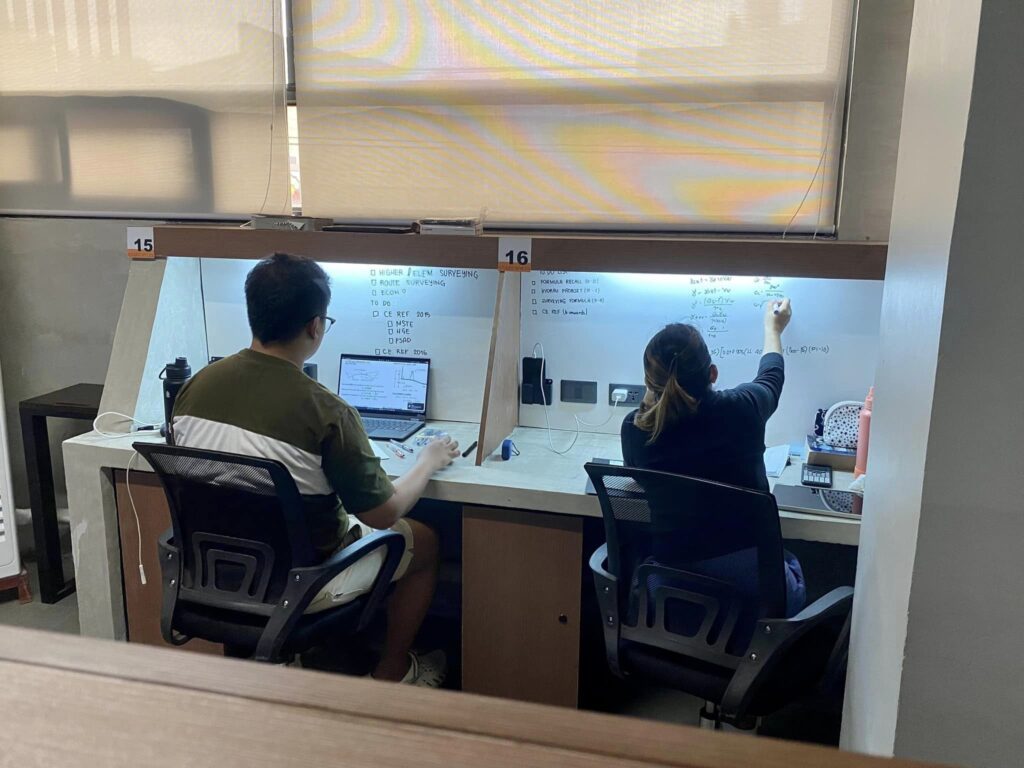
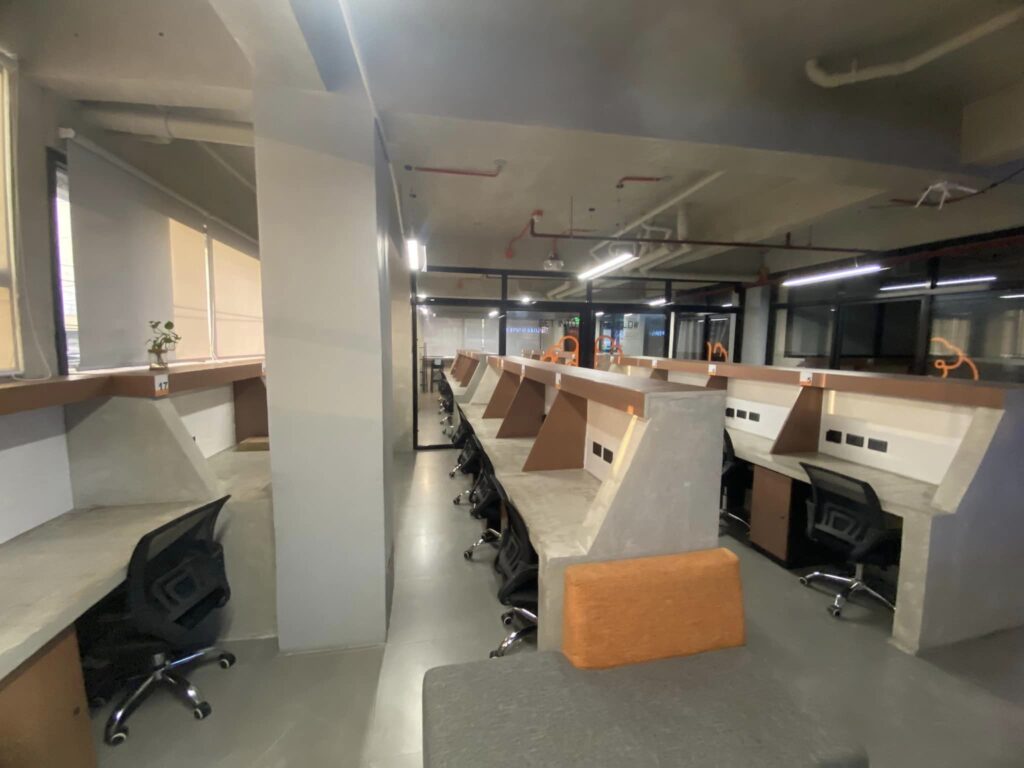
I am Studeo Spaces, the creator of Studeo Spaces Study Hub, where you can truly Get Into the Flow. As Sampaloc's top destination for achieving the "Flow State," my space is meticulously designed to enhance productivity and concentration for studying or working. I wanted to provide a supportive environment free from distractions, allowing students and professionals to unlock their full potential. Whether you're gearing up for exams or striving for peak performance, Studeo Spaces Study Hub offers the ideal atmosphere to help you reach your goals. Join me in this journey to unleash your focus and tap into your inner flow.
AS REQUESTED, Barkadaral Rooms can now be rented for as short as FOUR HOURS! And Barkadaral Room 10 (for up to 12 people) is now available. Please check out the revised post below:
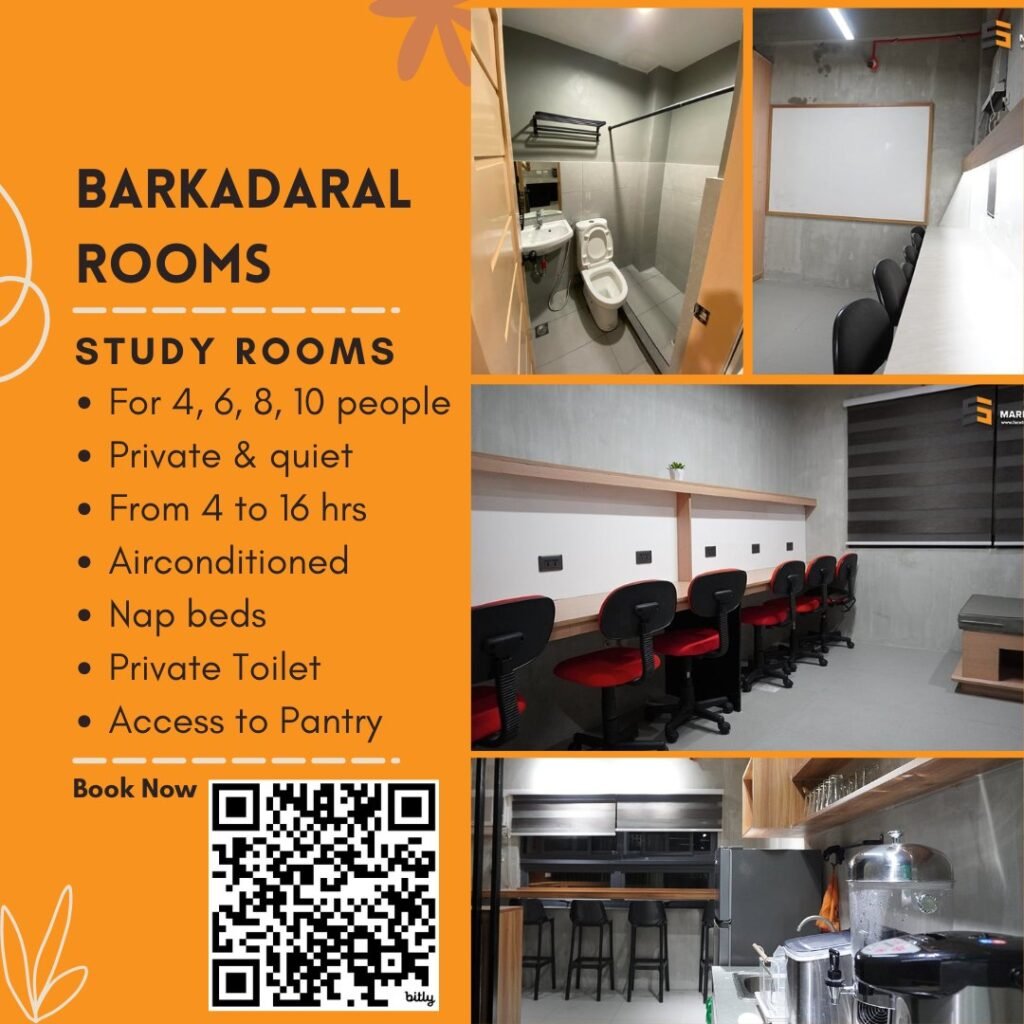
BARKADARAL ROOM FOR FOUR, SIX, EIGHT OR 10 PEOPLE
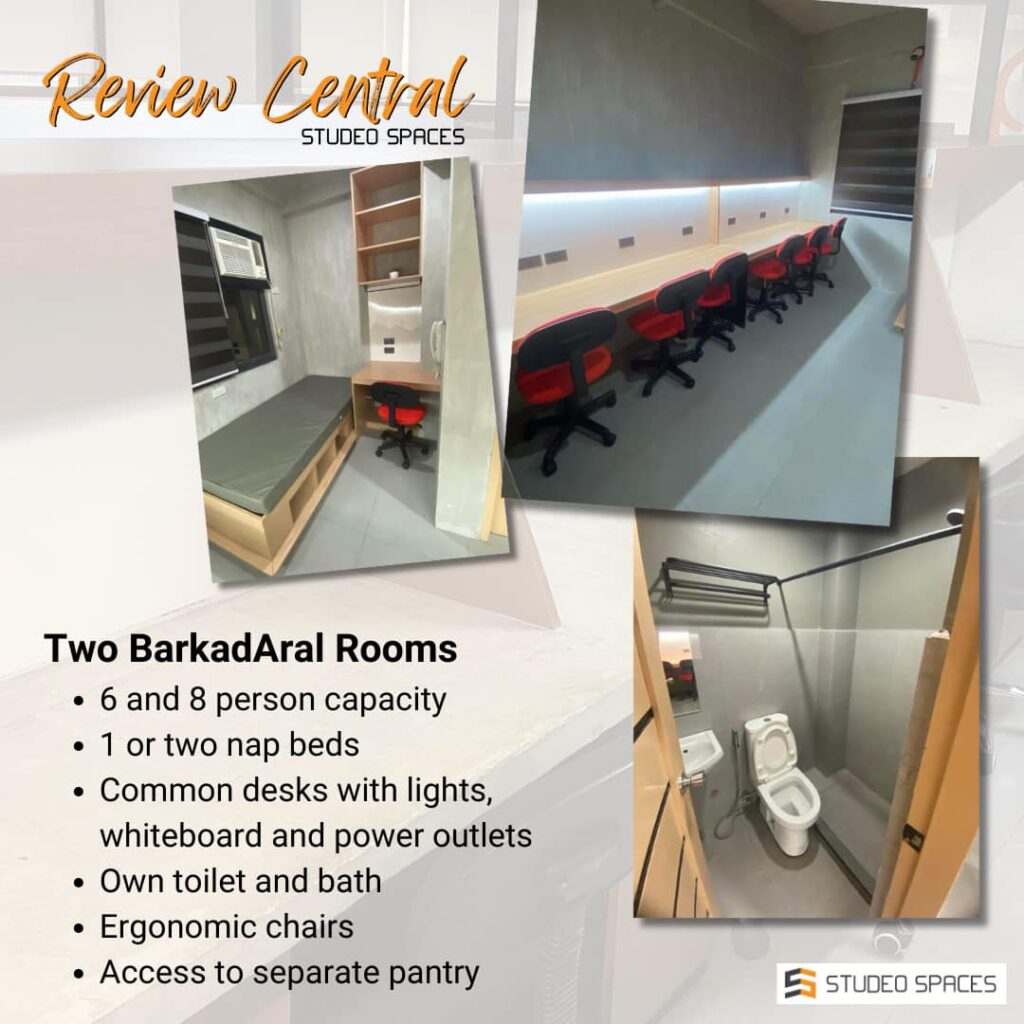
Designed for hyper-focused group study and work for groups of 4, 6, 8 or up to 10 people.
Exclusive private study with one or two lie-flat nap beds
Ensuite toilet and bath with bidet and water heater
Desks with lights, power outlets, and whiteboards
Soundproofed, airconditioned room for discussions, group study, thesis defense, etc.
Access to same-floor pantry
Dedicated high-speed, fiber broadband internet with its own access point
Advanced booking is needed, or walk-in if available.
Barkadaral Room hours are from 8:00 AM to 12:00 MN only. No overnight stay allowed.
BarkadAral Room Rates
BarkadAral Room 4 – good for 3 or 4 people with four desks and 2 lie-flat nap beds
P750.00 for 4 hours
P1000.00 for 8 hours
P1,500.00 for 16 hours (8:00 AM to 12:00 MN)
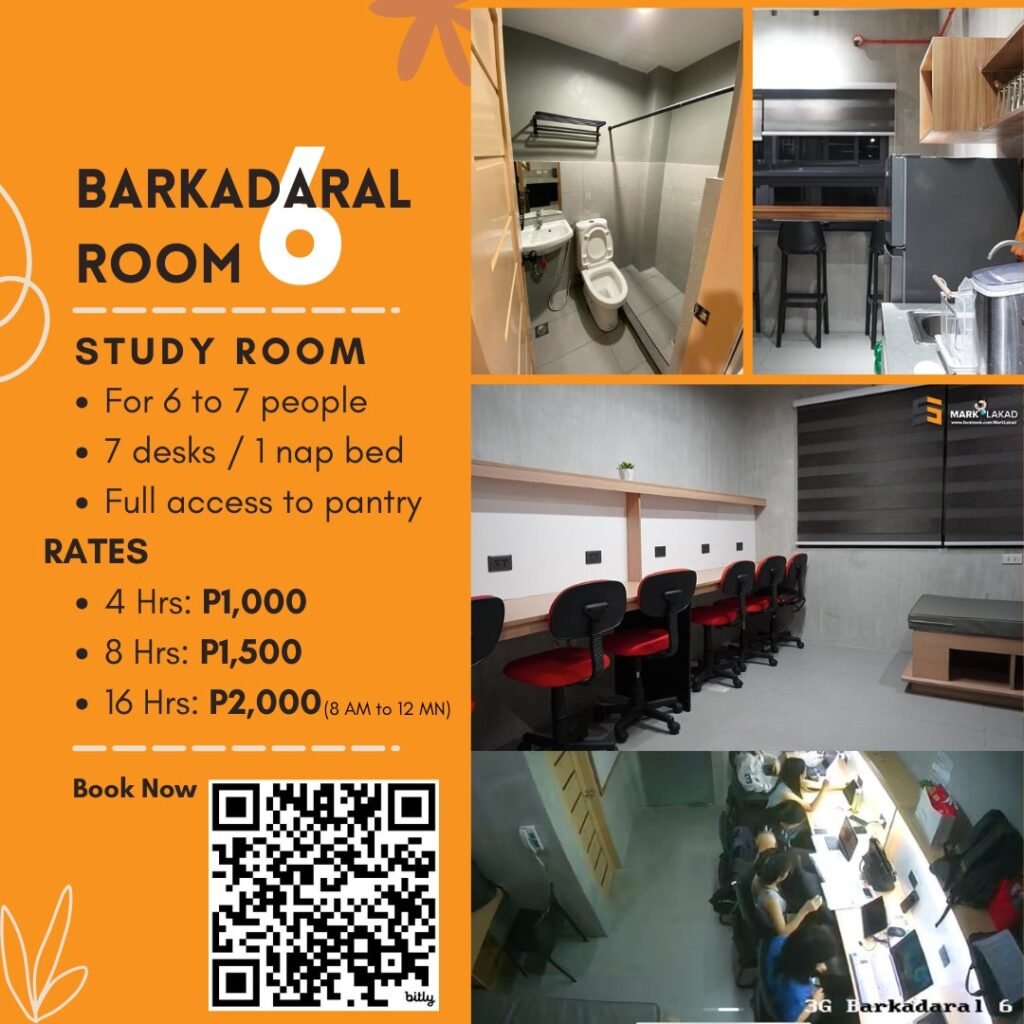
BarkadAral Room 6 – good for 5 to 7 people with 7 desks and 1 lie-flat nap bed.
P1,000.00 for 4 hours
P1,500.00 for 8 hours
P2,000.00 for 16 hours (8:00 AM to 12:00 MN)
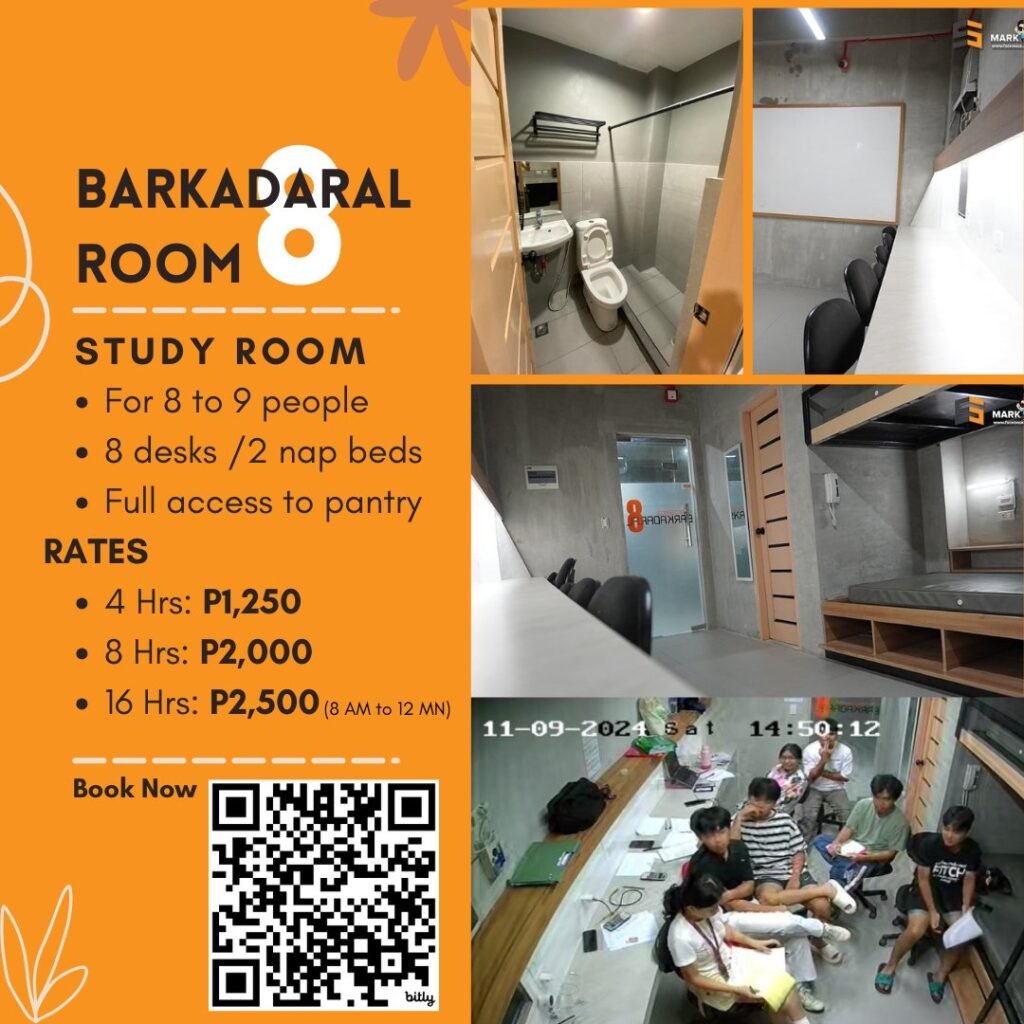
BarkadAral Room 8 – good for 8 to 9 people with 8 desks and 2 lie-flat nap beds.
P1,250.00 for 4 hours
P2,000.00 for 8 hours
P2,500.00 for 16 hours (8:00 AM to 12:00 MN)
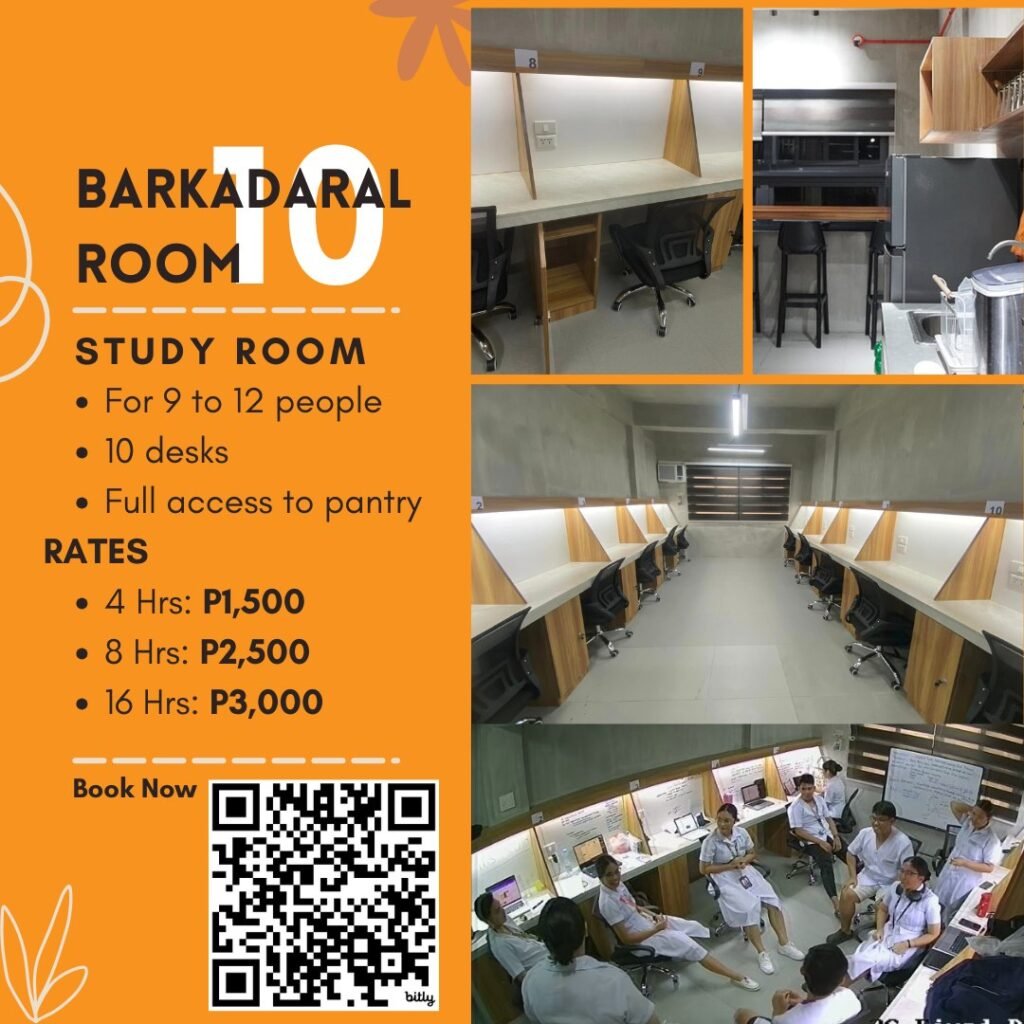
BarkadAral Room 10 – good for 10 to 12 people. Two additional chairs can be requested.
P1,500.00 for 4 hours
P2,500.00 for 8 hours
P3,000.00 for 16 hours (8:00 AM to 12:00 MN)
Studeo Spaces Study Hub is located at the corner of Dapitan and Dela Fuente Streets, Sampaloc, Manila (7-11 on the ground floor). Google Maps/Waze/Grab Pins: Studeo Suites or Studeo Spaces
We are open from 8:00 AM to 12 MN, seven days a week, including holidays and inclement weather. We do not close due to private events since we don’t host them.
Frequently Asked Questions About BarkadAral Rooms
What are BarkadAral Rooms at Studeo Spaces and who are they intended for?
BarkadAral Rooms are private, soundproofed study spaces designed for group study and work. They are ideal for groups of 4 to 12 people who need a focused environment for discussions, collaborative projects, or thesis preparation. These rooms are equipped with multiple desks, power outlets, whiteboards, and lie-flat nap beds for relaxation.
What features and amenities are included in a BarkadAral Room? Each BarkadAral Room includes:
Multiple desks with individual lights and power outlets One or two lie-flat nap beds A private ensuite toilet and bath with a bidet and water heater Whiteboards for brainstorming Soundproofing and air conditioning Access to a shared pantry on the same floor Dedicated high-speed, fiber broadband internet with its own access point
What are the different BarkadAral Room sizes and how many people can each accommodate?
There are four BarkadAral Room sizes available: BarkadAral Room 4: Suitable for 3 to 4 people, with four desks and 2 lie-flat nap beds. BarkadAral Room 6: Suitable for 5 to 7 people, with seven desks and 1 lie-flat nap bed. BarkadAral Room 8: Suitable for 8 to 9 people, with eight desks and 2 lie-flat nap beds. BarkadAral Room 10: Suitable for 10 to 12 people; two additional chairs can be requested.
What are the rental rates for BarkadAral Rooms and how long can they be rented for?
BarkadAral rooms can be rented for 4, 8 or 16 hours, within the operating hours of 8:00 AM to 12:00 MN. The rental rates vary by room size and rental duration: 4-Hour Rates: P750.00 (Room 4), P1,000.00 (Room 6), P1,250.00 (Room 8), P1,500.00 (Room 10) 8-Hour Rates: P1000.00 (Room 4), P1,500.00 (Room 6), P2,000.00 (Room 8), P2,500.00 (Room 10) 16-Hour Rates: P1,500.00 (Room 4), P2,000.00 (Room 6), P2,500.00 (Room 8), P3,000.00 (Room 10)
Can I book a BarkadAral Room in advance or can I walk in?
Advanced booking is recommended to ensure availability. Walk-ins are possible if rooms are available.
What are the operating hours for Studeo Spaces and the BarkadAral Rooms?
Studeo Spaces and the BarkadAral Rooms are open from 8:00 AM to 12:00 MN, seven days a week, including holidays and inclement weather. Overnight stays are not permitted in the BarkadAral Rooms.
Where is Studeo Spaces located?
Studeo Spaces is located at the corner of Dapitan and Dela Fuente Streets, Sampaloc, Manila. It shares the ground floor with a 7-11 convenience store. The location can be found on Google Maps/Waze/Grab by searching for “Studeo Suites” or “Studeo Spaces”.
Does Studeo Spaces offer other services or types of study spaces besides the BarkadAral rooms?
Yes, Studeo Spaces also offers Solo Rooms and the “Glassbox Night Shift” rooms, as well as desk spaces. They also offer various passes, including all-day, all-night passes and prepaid passes. They also have a coffee shop, Rekap Barista Coffee, located in the space.
Unleash Your Learning Potential: Mastering the SQ3R Method for Academic and Exam Success: The journey of learning, whether for completing a college course or conquering the formidable board exams, demands more than passively reading materials. It requires an active, strategic approach to processing and retaining information. Enter the SQ3R method, a powerful reading and study technique to enhance comprehension and memory. This blog post will delve into the depths of the SQ3R method, exploring its principles, practical applications, and how it can be your secret weapon for achieving academic excellence and board exam success.
What is the SQ3R Method?
The SQ3R method, developed by educational psychologist Francis P. Robinson in the 1940s, is a structured approach to reading comprehension that involves five key steps: Survey, Question, Read, Recite, and Review. It’s not just about passively absorbing words; it’s about actively engaging with the material to deepen understanding and promote long-term retention.
Here’s a breakdown of each step:
Survey (S): Before diving into the text, take a few minutes to get an overview of the material. This is about familiarizing yourself with the landscape before embarking on a journey through the text.
Read the introduction and summary.
Examine headings and subheadings. These provide a roadmap of the main topics and concepts.
Look at visuals such as pictures, charts, and graphs.
Note any bolded or italicized words.
Skim the chapter’s conclusion and study questions.
Please note each paragraph’s first and last sentences, often highlighting the main idea.
This initial survey helps to provide a framework for the information you will be reading.
Question (Q): Transform headings and subheadings into questions. For example, if a heading reads “The Impact of Climate Change,” turn it into a question: “What is the impact of climate change?”.
This step is about creating a purpose for reading. Instead of passively reading, you actively search for answers to your questions.
Generate broader questions like, “What is this section about?” or “How could this information be useful to me?”.
This questioning approach is similar to elaboration, which connects new knowledge to existing knowledge.
Read (R): Engage with the text actively while searching for the answers to the questions you have created.
Focus on identifying the main ideas and supporting details.
Pay attention to transition words such as “next,” “for example,” and “in contrast” to understand the flow of ideas.
Make notes, summarize key points, and paraphrase information in your own words rather than copying directly from the text.
Highlight only the most essential points, as excessive highlighting can make distinguishing main ideas from supporting details difficult.
Keep the questions you have generated in mind when you read, making your reading experience more active.
Recite (R): After reading a section or chapter, recall what you have learned in your own words.
This can be done aloud or in writing, but the key is actively retrieving the information from memory.
Answer the questions you created earlier or those at the end of the chapter. If you can’t answer them, return to the text to review and take further notes.
This step is crucial for solidifying your understanding and transferring information to long-term memory. It is a form of retrieval practice that helps you check for comprehension.
Review (R): After studying new material, conducting an overall review within 24 hours is essential for maximum comprehension and memory.
Revisit the material after some time, ideally within 24 hours, to reinforce your learning. You can lose much of what you have learned if you do not review it within the next day.
Please review the questions you created earlier and try to answer them without looking at the text. This will help you identify any areas that need further attention.
Review may involve checking the answers or rereading the text, depending on when you review.
Why is SQ3R Effective?
The effectiveness of the SQ3R method stems from its ability to engage the reader actively in the learning process. By combining surveying, questioning, reading, reciting, and reviewing, SQ3R taps into several key cognitive processes that promote better understanding and retention:
Organization: The survey step helps you create a mental framework for the information before you begin reading. Organization is key for understanding and retaining information.
Active Engagement: Generating questions and searching for answers transforms reading from a passive activity into an active pursuit.
Elaboration: By creating questions, you connect new information with existing knowledge, and if they’re answering those questions during the reading phase, they are actively elaborating on the material.
Retrieval Practice: Reciting the information in your own words is a form of retrieval practice, a powerful strategy for strengthening memory.
Spaced Repetition: The review step reinforces your learning over time, a key element for long-term retention.
Adapting SQ3R for Different Learning Styles and Situations
While the core principles of SQ3R remain consistent, it’s essential to recognize that different individuals may find variations that suit their learning styles better. Some might find that creating elaborate questions works best, while others find that summarizing what they read is most effective. The SQ3R method is a flexible framework, not a rigid set of rules. Here are some ways to adapt it:
Flexibility is key: You don’t have to follow all the steps. Use what works best for you.
Tailor Your Questions: Adjust the types of questions you generate based on your needs and the material’s complexity. You can ask general questions to understand the content or more specific questions to address particular aspects.
Choose Your Method of Recitation: Find a method of recitation that suits you, whether speaking aloud, writing notes, or creating mind maps.
Vary Your Review: Try different review techniques like rereading, summarizing, or teaching the material to someone else.
Beyond SQ3R: Exploring the 3R Approach
Recent research suggests that the core of SQ3R, the 3Rs of read, recite, and review, can be a highly effective method. Some experts propose that the survey and question components can be challenging to master and assess, as their effectiveness depends heavily on the quality of the questions. The 3R approach is quick to teach, efficient during study, and effective for learning.
Enhancing Your Study Strategy with SQ3R
The SQ3R method is more than just a reading technique; it’s a comprehensive study strategy that can transform how you learn and approach exams. Here are some tips on how to maximize the effectiveness of SQ3R for both academic studies and board exam preparation:
Create a Study Schedule: Integrate the SQ3R method into your study routine. Plan your study sessions so that you can dedicate time to each step.
Be Selective When Highlighting and Note-Taking: Focus on essential points and paraphrase or summarize in your own words.
Use Marginal Notes and Summaries: Write down questions or your responses to questions in the margins. Use summaries to condense information.
Relate New Material to What You Already Know: When you study a chapter, try to link new facts, terms, and concepts with information you already know.
Incorporate Different Learning Techniques: Use visuals, videos, or discussions to complement your SQ3R reading.
Practice Regularly: The more you practice the SQ3R method, the more natural and effective it will become.
The Power of Review and SQ4R
Remember, consistent review is critical for success. Please review what you’ve read within 24 hours to help you remember it, and continue to review it frequently until you are comfortable with the material. Additionally, you may want to consider a variation called the SQ4R method, which adds another “R” to the process, which could be “Relate,” “Write,” “Record,” “Reflect,” or “Respond,” adding further depth to the method.
Does Research support SQ3R?
While the theoretical foundations of SQ3R are robust, the empirical research supporting its effectiveness is mixed. This is likely due to inconsistencies in how the method is applied. The 3R method (Read, Recite, Review) has a more solid research foundation. The key to success with SQ3R lies in using the method appropriately and consistently, ensuring active engagement with the text, and regularly reviewing the material.
Conclusion
The SQ3R method provides a structured approach to reading comprehension that can significantly enhance your study habits. By actively engaging with the text through surveying, questioning, reading, reciting, and reviewing, you can improve your understanding, retention, and, ultimately, your performance in your academic pursuits and board exams. While it may take some practice to master, the potential benefits are immense. Whether you stick to SQ3R Method, or streamline it to 3R, tailor it to your learning style and study requirements. With consistent practice, SQ3R can become an invaluable tool in your academic journey and help you achieve the success you deserve.
Frequently Asked Questions About the SQ3R Method
What is the SQ3R method, and what does each step entail?
The SQ3R method is a reading comprehension strategy designed to enhance understanding and retention of written material. It consists of five steps: Survey (skimming the text to get an overview), Question (generating questions about the content), Read (actively reading to find answers), Recite (recalling and explaining the content in your own words), and Review (revisiting the material to reinforce learning).
How do you effectively survey a text according to the SQ3R method?
Surveying involves scanning the material to grasp its structure and main ideas before diving into detailed reading. This includes looking at titles and headings, visual aids like pictures or graphs, introductory and concluding paragraphs, and any questions or summaries included in the text. The goal is to create a mental framework of the material.
Why is generating questions considered a key step in the SQ3R process?
Formulating questions transforms reading from a passive activity to an active one. By turning headings into questions or creating general inquiries about the text (e.g., “What is this about?,” “How is this relevant to me?”), readers create a purpose for their reading. Searching for answers to these questions facilitates deeper engagement and comprehension.
What does the ‘Recite’ or ‘Recall’ step of the SQ3R method involve and why is it important?
The ‘Recite’ step requires you to explain what you have just read in your own words, orally or in writing. It’s crucial because this process of active recall helps solidify the information in your long-term memory. It checks your understanding, goes beyond simply reading, and allows you to process and synthesize the material actively.
How does the ‘Review’ step contribute to the overall effectiveness of SQ3R?
The review step is crucial for long-term retention. It involves reviewing the material, trying to answer the questions you generated earlier, and reinforcing your understanding of the main ideas. Reviews are more effective when they happen soon after reading, ideally within 24 hours, to prevent significant memory loss of the studied material.
Is the SQ3R method universally agreed upon and supported by empirical research?
While the underlying principles of SQ3R align with effective learning strategies such as elaboration, organization, and retrieval practice, there isn’t complete consensus on its application. Studies have shown mixed results, likely due to variations in how people implement each step. Some research indicates that the core elements of Read, Recite, and Review are practical while the Survey and Question steps might be more challenging to execute effectively.
What is the ‘4th R’, and how does it expand upon the SQ3R method?
The “4th R” expands upon the basic SQ3R model with variations such as: Relate, connecting new information to existing knowledge or personal experiences to deepen understanding; wRite, involving note-taking, outlining, or summarizing to reduce the info; Record, highlighting or annotating the text to identify key ideas for later review; Reflect, which asks you to think about the material’s significance; and Respond, to seek and note answers to questions in the margins.
How can the SQ3R method, or its core principles, be adapted for more effective learning?
If the SQ3R method doesn’t work as intended, focus on its core elements – actively reading with questions, reciting or recalling key information, and spaced review. You can choose one of the additional “R” methods. Ensure you’re creating high-quality, elaborative questions, that your initial survey genuinely assists with the organization of understanding, and that your recitation is an active retrieval exercise. You might consider dropping the study and question aspects and focusing solely on the read, recite, and review components as an efficient and effective method if you have difficulty mastering the question component.
SQ3R Method Glossary of Key Terms
Active Reading: Engaging with text in a way that promotes understanding, critical thinking, and retention rather than passively absorbing words.
Elaboration: The process of connecting new information to existing knowledge, helping to build a deeper understanding and promoting memory.
Empirical Support: Evidence derived from research, experiments, or observations used to validate claims or theories.
Free Recall: The ability to retrieve information from memory without prompts or cues, often tested by simply asking a learner to record as much as possible about the material.
Inference Questions: Questions that require a reader to use details within a text and prior knowledge to draw a conclusion that is not explicitly stated.
Retrieval Practice: Actively recalling information from memory, a powerful technique to enhance material retention over time.
Reread: The simple act of going back over a text a second or third time.
Spaced Repetition: A learning technique that involves reviewing information at increasing intervals to strengthen long-term memory and retention.
SQ3R: A reading comprehension method comprised of five steps: Survey, Question, Read, Recite, and Review.
3R: A modified SQ3R reading method consisting of only three steps: Read, Recite, and Review.
Rekap Barista Coffee is now at Studeo Spaces! Studying at Studeo Spaces has become a lot more fun (and caffeinated)!
Studeo Spaces Study Hub and Recap Cafe collaborate for an ELEVATED STUDY AND COFFEE EXPERIENCE!
We will now have an onsite coffee shop powered by REKAP!
And to kick off the collaboration, we are offering the Study and Sip @ Studeo Spaces (S4) Promo starting November 11, 2024, at 11:00 AM.
Now, you can avail yourself of the All-Day Study Pass and a Select Drink (coffee or non-coffee) for the low price of only P300! A savings of P30 to P50!
Just let Ate Sol know that you will be availing of the Study and Sip Promo when you pay for the All-Day Pass. Pay P300 instead of P250, and you will be given a REKAP Drink voucher. Head to the coffee counter, tell the barista your choice of drink and desk number, and give the voucher. Your drink will be delivered to your desk in no time.
What is REKAP (Capture the flavor, rewind the experience)?
REKAP is a film-inspired coffee shop, but this isn’t your ordinary “themed shop.” Our theme is not only aligned with the aesthetic of the shop, but it’s more aligned with the flavors of our drinks, such as Moana, The Addams, and Inside Out; we also have limited series like House of the Dragon, etc.
Our coffee will surely please your eyes and palate. From its artistic presentation to the flavor of each drink, it will surely not disappoint.
If there’s a phrase to describe REKAP, it would be “when coffee meets creativity”.
Our brand offers high-quality coffee while giving our customers a unique experience!
Frequently Asked Questions About Rekap Cafe and Studeo Spaces
What is the new collaboration at Studeo Spaces?
Studeo Spaces has partnered with REKAP Barista Coffee to offer an on-site coffee shop, enhancing the study experience with a blend of quality coffee and a conducive study environment.
What is the “Study and Sip” promo, and how does it work?
The “Study and Sip @ Studeo Spaces (S4)” promo offers an All-Day Study Pass along with a select drink (coffee or non-coffee) from REKAP for a discounted price of P300. To avail of this, inform “Ate Sol” when paying for the All-Day Pass, pay P300 instead of the regular price and receive a REKAP drink voucher. You will then give the voucher at the coffee counter, tell the barista your drink of choice and your desk number, and your drink will be delivered.
What is unique about REKAP coffee?
REKAP is a film-inspired coffee shop that aims to align its drink flavors with specific themes, drawing inspiration from movies like Moana, The Addams, and Inside Out and limited series such as House of the Dragon. The shop emphasizes artistic presentations and unique flavors to provide customers with a creative and high-quality coffee experience.
How would you describe the REKAP brand?
The REKAP brand is described as the intersection of coffee and creativity, offering high-quality coffee while focusing on a unique, film-inspired experience. Their tagline is “Capture the flavor, rewind the experience,” emphasizing both taste and the overall atmosphere.
What are the various study space options available at Studeo Spaces?
Studeo Spaces offers several options: All-Day, All-Night Passes, 15-Day Prepaid Passes, and dedicated desks. They also provide private rooms, including “Barkadaral” rooms, solo rooms, and a “Glassbox Night Shift” option.
What other services and facilities does Studeo Spaces provide?
Studeo Spaces offers amenities suitable for studying, including booking options for desks or rooms, online articles about study strategies and exam preparation, and payment options which include credit, debit and e-wallets.
What kind of content can be found on the Studeo Spaces website?
The Studeo Spaces website includes blog articles about study strategies, exam preparation, study flow state, study hub lists in Manila, and relevant site news. They also provide information on rates, features, location, and site policies.
How does Studeo Spaces focus on study strategies?
Studeo Spaces provides articles on a range of study topics, such as “Study and Review Strategies and Tips,” “How To Stay Motivated While Studying For Board Exams,” “Top Ways To Improve Your Exam-Taking Skills,” and “Best Ways To Manage Exam Anxiety.” They also offer resources on maximizing productivity with “Flow State in Studying.”convert_to_textConvert to source
We will be closed from 21:01 AM on October 31, 2024, to November 2, 2024, to install air conditioning units in our second-floor general area and some minor renovation work.
We will see you again on November 3, 2024, at 8:00 AM when our regular business hours (8:00 AM to 6:00 AM) resume.
Are you a student juggling classes, assignments, and extracurriculars? Or perhaps you’re deep in the trenches of board exam prep, feeling the pressure mount with each passing day? If so, you’re likely familiar with the overwhelming feeling of having too much to do and insufficient time. It’s an everyday struggle that can lead to procrastination, anxiety, and, ultimately, less-than-optimal results. But what if there was a simple yet effective method to transform your relationship with time, allowing you to achieve peak productivity and academic success? Enter the Pomodoro Technique.
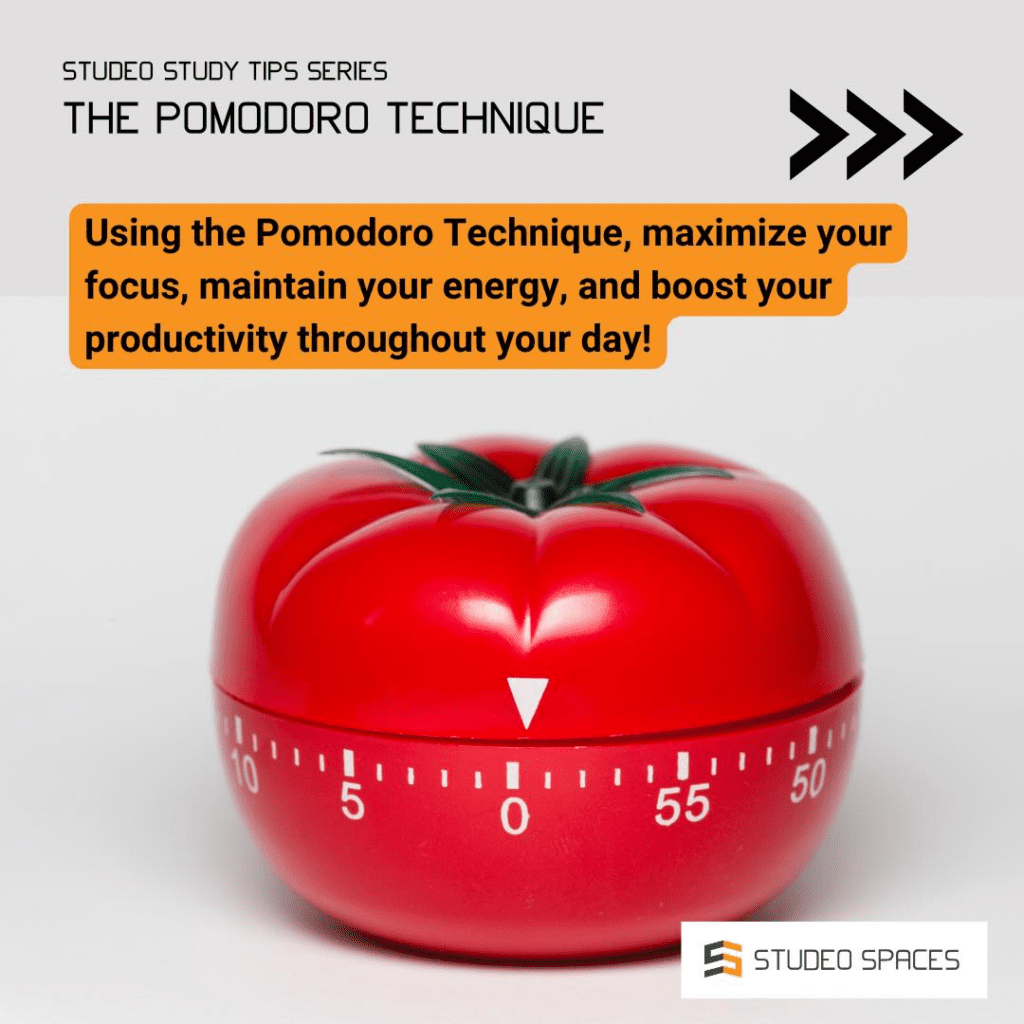
The Pomodoro Technique, developed by Francesco Cirillo in the late 1980s, is a time management method that breaks down work into focused intervals separated by short breaks. It’s named after the tomato-shaped kitchen timer Cirillo initially used to track his study sessions. This technique isn’t just about managing time; it’s about managing your focus, energy, and productivity.
Why the Pomodoro Technique Works
At its core, the Pomodoro Technique aims to address the real problem of “time anxiety” – that feeling of being overwhelmed by deadlines and the sensation that time is slipping away. This anxiety often leads to procrastination and ineffective study habits. The Pomodoro Technique reframes time as an ally rather than an enemy by providing a structured approach to work.
Here’s how the Pomodoro Technique can benefit students and those preparing for board exams:
Enhanced Focus and Concentration: The 25-minute work intervals (known as Pomodoros) are designed to maximize concentration. Knowing that you only have to focus for a set amount of time makes the task less daunting. This can be especially beneficial when dealing with complex material or topics that tend to cause distraction. The focused work period also reduces the tendency to procrastinate by making the task feel more manageable. The technique also encourages you to recognize and note down distractions so that you don’t act upon them until a set time. This helps to keep you focused on the work at hand.
Reduced Mental Fatigue: Short breaks of 3-5 minutes between Pomodoros and longer breaks of 15-30 minutes after every four Pomodoros are essential for mental rejuvenation. These breaks allow your mind to assimilate information and recharge, preventing burnout and mental exhaustion. These breaks are not just moments of rest but opportunities to disconnect from work, stretch, or grab a drink, which helps optimize focus for the next Pomodoro.
Improved Time Estimation: As you consistently use the Pomodoro Technique, you become more attuned to how much time specific tasks require. By tracking your Pomodoros, you better understand the effort involved in your work. This improved estimation can significantly enhance your planning skills and help you create more realistic study schedules.
Effective Management of Interruptions: One of the biggest challenges for students is managing internal and external distractions. The Pomodoro Technique addresses this directly by helping you identify and manage those interruptions. Internal interruptions (the urge to check social media) are managed by noting the distraction using an apostrophe (‘) and continuing your work until the end of the Pomodoro. External interruptions (a phone call or a chatty roommate) are handled using the “Inform, Negotiate, and Call Strategy”, where you politely say that you’re busy, note the interruption with a dash (-), and plan to address the interruption later. You can minimize disruptions during focused work time by noting interruptions but not acting on them immediately.
Increased Awareness of Work Habits: Recording completed Pomodoros, tracking interruptions, and reflecting on your productivity provides invaluable insight into your work habits. This self-observation empowers you to identify areas for improvement and refine your study strategies for maximum efficiency. By observing how you work, you can optimize your routine and adjust your schedule to maximize your productive periods.
Enhanced Motivation: The Pomodoro Technique creates a sense of accomplishment through the completion of each Pomodoro and each set of four Pomodoros. This structured approach allows you to break down large tasks into smaller, manageable units that can make your work appear less daunting. This creates a continuous sense of progress that can significantly boost your motivation and commitment to your academic goals.
How to Implement the Pomodoro Technique
Getting started with the Pomodoro Technique is surprisingly easy. All you need is a timer, a “To Do Today Sheet,” an “Activity Inventory Sheet,” and a “Record Sheet”. You may use the paper versions described in the document or an electronic version if it suits you. Here’s a step-by-step guide:
Plan Your Day: Create a “To Do Today Sheet” list of tasks you need to complete, organized by priority. The sheet should also include an area for unplanned and urgent activities. This sheet helps you stay organized and ensures that you have a clear plan for the day.
Choose a Task: Select a task from your “To Do Today Sheet” that you want to work on. Consider the effort required for each task, using estimates from your “Activity Inventory”.
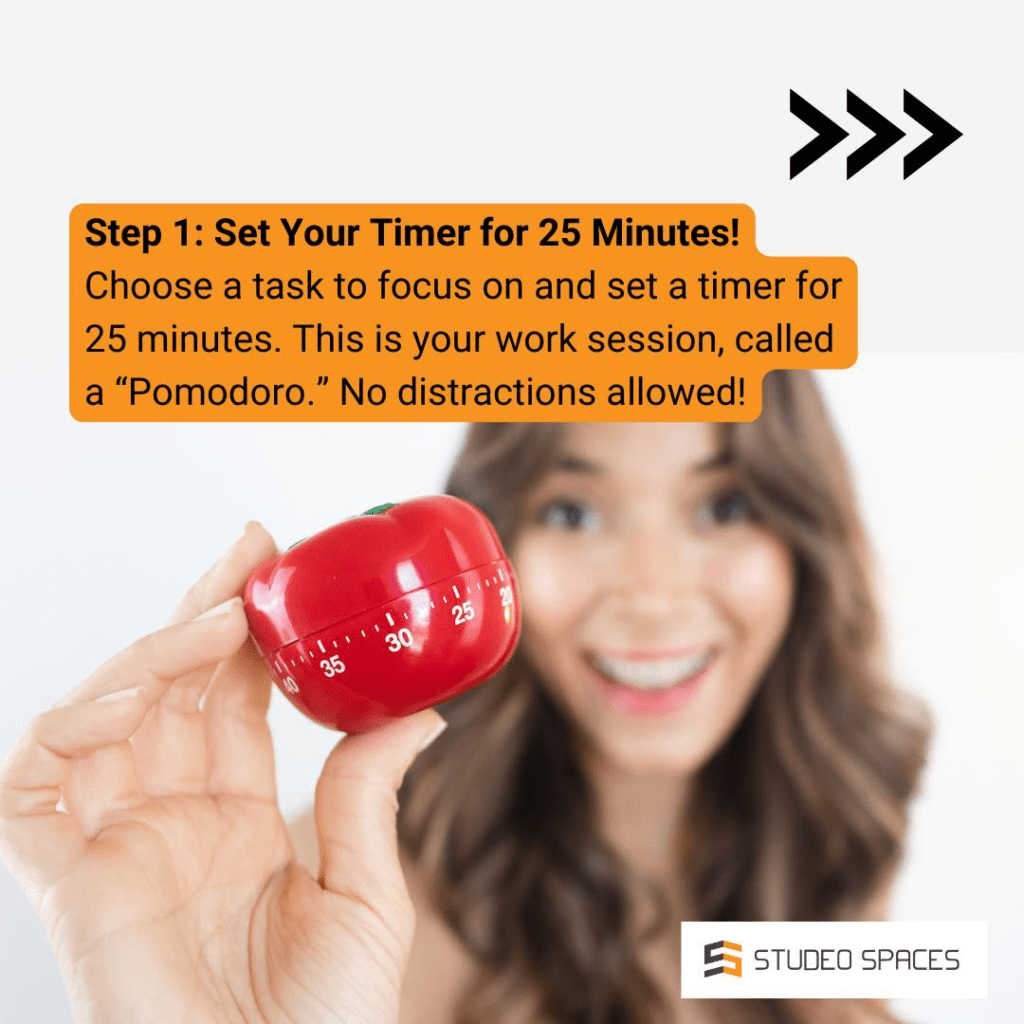
Set the Timer: Set a timer for 25 minutes. This marks the beginning of your first Pomodoro. The timer must be visible while you work.
Work Intently: Focus solely on the chosen task for the entire 25 minutes without any interruptions. If an interruption arises, note it but do not act upon it. The Pomodoro is indivisible, and any interruption that derails the work makes that Pomodoro void.
Take a Short Break: Take a 3-5 minute break when the timer rings. This should be a period of rest and mental disengagement, like doing some stretches or drinking water. Avoid doing anything that requires mental effort during this break.
Record Your Progress: Mark an “X” on your To Do Today Sheet next to the completed task. This helps you to track your progress and stay aware of how much you have accomplished.
Repeat: Repeat steps 2-6 for three more Pomodoros. At this point, you have completed one full “set.”
Take a Long Break: After completing four Pomodoros, take a longer break of 15-30 minutes. This is the time to do something more involved, like tidying up your desk, checking emails, or going for a quick walk.
Continue: Resume the cycle until all your tasks are complete. Remember to take breaks after every Pomodoro and after every four Pomodoros until the work for the day is finished.
Record and Reflect: At the end of the day, transfer your completed Pomodoros and other notes to the “Records Sheet”. This sheet provides a space to reflect on your productivity and plan for improvements in your next study session.
Tools for Success
While any timer can be used, consider using a dedicated “Pomodoro timer” or app, which clearly shows the time remaining. There are many apps available that can also help you track your progress, manage interruptions, and gain insights into your study habits. The source mentions “PomodoroMobile by XPLabs” and “JTomato by Bruno Bossola” as examples of such apps. However, the source states that physical timers may be preferable since winding the timer represents the commitment to start working.
Customizing the Pomodoro Technique
The Pomodoro Technique is not a rigid, one-size-fits-all approach. Instead, it’s a flexible framework tailored to your specific needs and preferences. Some ways to customize it are:
Adjusting the Length of the Pomodoro: The default is 25 minutes, but some may find a slightly longer or shorter duration to be more effective for them. However, according to the source, a Pomodoro should never be shorter than 20 minutes or longer than 40 minutes.
Varying the Length of Breaks: The length of breaks can be adapted based on your energy levels. A slightly longer break can be beneficial if you’re feeling particularly drained. Generally, the breaks between sets can be extended beyond the usual 15-30 minutes if needed, but the breaks between Pomodoros should still stay within the 3-5 minute range.
Experimenting With Set Structures: You can organize your Pomodoro sets to fit your timetable, combining Pomodoros to work on specific tasks. You may also assign some Pomodoros to planning and analysis, allowing you to keep up with your studies.
Managing Exploration Time: When starting a new project, allow for exploration time to plan and prepare. Use a set number of Pomodoros for the exploration process, then re-evaluate once the time is up to decide whether more exploration is necessary or if you are ready to start the work.
The Pomodoro Technique and Board Exam Preparation
The Pomodoro Technique benefits board exam preparation by focusing on structured study and preventing burnout. When studying for the boards, the amount of material can be overwhelming. The Pomodoro Technique helps break down this enormous task into manageable 25-minute chunks of focused study. Combining Pomodoro sets with short breaks and review periods allows you to make the most of your time and work toward a manageable rhythm. This method provides for sustained periods of focus while also giving enough breaks to keep you from feeling overwhelmed or exhausted.
Final Thoughts
The Pomodoro Technique isn’t just another time management fad; it’s a powerful tool for enhancing your focus, productivity, and well-being. Whether you’re a student aiming for top grades or someone diligently studying for the boards, this technique can be a game-changer in your academic journey. By understanding and embracing the principles of the Pomodoro Technique, you can transform your relationship with time and achieve the success you deserve. Remember, the most critical aspect of this technique is to work consistently, without breaks, until the Pomodoro rings, no matter what. Give the Pomodoro Technique a try and witness how much you can accomplish when time becomes your ally rather than your enemy.
Frequently Asked Questions About the Pomodoro Method
What is the core idea behind the Pomodoro Technique, and how does it differ from traditional time management approaches?
The Pomodoro Technique is centered on the idea of working in focused 25-minute intervals called “Pomodoros,” followed by short breaks (3-5 minutes). After every four Pomodoros, you take a longer break (15-30 minutes). It shifts away from the common perception of time as an enemy, which leads to anxiety and procrastination, by giving structure and a sense of control over time. The main difference from traditional approaches is its emphasis on working in short, indivisible intervals to maximize concentration and prevent burnout and mental fatigue, as well as its focus on self-observation and self-improvement rather than external monitoring.
What are the five objectives of the Pomodoro Technique, and why are they important?
The Pomodoro Technique has five core objectives. These include: (1) Measuring Effort: learning to recognize how much effort specific activities require by recording your completed pomodoros; (2) Cutting Down Interruptions: learning to manage both internal (thoughts, urges) and external (phone calls, colleague interruptions) interruptions to maintain focus during a pomodoro; (3) Estimating Effort: predicting how many pomodoros an activity will take, which aids in planning; (4) Increasing Effectiveness: optimizing both individual pomodoros and sets of pomodoros to maximize the benefits; and (5) Setting Up a Timetable: creating a schedule that fits your needs by organizing your sets of pomodoros and breaks into a daily format. These objectives are important because they focus not just on how you use time, but how well you estimate the time and handle common workplace disruptions. These objectives work together to gradually improve your time management habits and productivity.
How does the Pomodoro Technique handle interruptions, and why is this method so specific?
The Pomodoro Technique differentiates between internal and external interruptions. When an internal interruption (e.g., wanting to check social media) occurs, you mark it with an apostrophe (‘) on your record sheet, note down the interruption in the Activity Inventory and/or on the “To Do Today” list, but continue your work on the current Pomodoro. When an external interruption (e.g., phone call) occurs, you mark it with a dash (-) and use the “Inform, Negotiate, and Call Strategy” by stating you cannot be disturbed and will call them back after your Pomodoro ends. The method is specific because it teaches us not to immediately act on the interruption, but to acknowledge it and deal with it later in a set format, thus preserving the integrity of the Pomodoro.
What tools or methods are used within the Pomodoro Technique?
Several planning and tracking tools are used alongside the pomodoros themselves. These include a “To Do Today Sheet,” for daily tasks, including a section for urgent and unplanned activities. There is also an “Activity Inventory Sheet” which lists tasks, their estimated effort in pomodoros, and their deadlines. Finally, there is the record sheet, where completed pomodoros, and interruptions are recorded to measure and observe patterns. These tools are used to assist in the continuous observation, feedback, and iteration that are a core part of the Pomodoro Technique.
Why are breaks considered such a crucial part of the Pomodoro Technique?
Breaks are vital because they allow the mind to recover from the focused work period. Short breaks (3-5 minutes) after each Pomodoro give you a moment to decompress, while longer breaks (15-30 minutes) after four Pomodoros provide a more substantial opportunity to rest and recharge. They enable better assimilation of the material learned during work periods, prevent mental fatigue, and help you stay refreshed and focused for subsequent tasks. Breaks aren’t seen as “wasted” time, but essential for the efficiency of the system.
How does the Pomodoro Technique address the common problem of procrastination?
The Pomodoro Technique addresses procrastination in several ways. By breaking work into small, manageable units (25-minute pomodoros), the task doesn’t seem as overwhelming. The indivisible nature of the Pomodoro and its structured start and stop times also help counter the tendency to drift off task. By making it a game or goal to complete a single pomodoro without interruption, motivation increases. The technique emphasizes starting an activity rather than worrying about finishing it, which can be a major hurdle for those who procrastinate. The technique also suggests using a pomodoro for planning if you are feeling lost, and to re-evaluate priorities.
Is the Pomodoro Technique a rigid methodology, or is there room for personalization?
While the Pomodoro Technique has specific rules (such as the indivisibility of the Pomodoro) it also highly flexible. You can adapt it to different circumstances, schedules, and task types. You can change the number of pomodoros to work with your day’s schedule, and the technique emphasizes observing your own habits to find what works best for you, rather than being a rigid system that dictates everything. The system is meant to be user-centered and to empower personal improvement.
What is meant by the “Becoming Syndrome,” and how does it relate to the Pomodoro Technique?
The “Becoming Syndrome” refers to the tendency to be too results-oriented, with a constant anxiety to demonstrate progress, often leading to a fear of not being fast enough or good enough. This can manifest as a desire to go as fast as possible, or being overly focused on accomplishing the most amount of tasks possible. The Pomodoro Technique helps to counteract this syndrome by emphasizing self-observation and improvement of your process. The focus is on measuring and observing your work and productivity habits to iterate upon them, and not solely on maximizing work output. The technique also helps prevent this “syndrome” by explicitly encouraging breaks and time away from the work process, helping an individual become less reliant on the completion of tasks for self-validation
Glossary of Terms for the Pomodoro Technique
Activity Inventory Sheet: A list of tasks to be completed, with estimations of effort in Pomodoros and deadlines, and used for planning and task management.
Becoming Syndrome: The tendency to be overly driven and results-oriented, often leading to stress and anxiety.
External Interruptions: Interruptions from outside the individual, such as phone calls or colleagues. Tracked with a dash (-).
Inform, Negotiate, and Call Strategy: A method for handling external interruptions involves informing the interrupter that you are busy, negotiating later to address the issue, and calling back as agreed.
Internal Interruptions: Interruptions, such as urges to check social media, originate from within the individual. Tracked with an apostrophe (‘).
Overestimation (Quantitative): Estimating a task will take more Pomodoros than it does, leading to a surplus of time at the end of the task.
Pomodoro: The basic unit of time in the Pomodoro Technique, a 25-minute work interval.
Qualitative Estimation Error: This occurs when all the necessary activities for a goal are not identified during planning, failing to anticipate all required work.
Quantitative Estimation Error: This occurs when an estimate of the required time for a single task is either higher (overestimation) or lower (underestimation) than the time needed to complete the task.
Record Sheet: A sheet where completed Pomodoros are tracked and archived to enable productivity review.
Soft-Pomodoro: Software replicating the traditional timer’s functions, often including additional options for sounds or notifications.
Time-boxing: A time management technique that assigns a fixed time interval to a task or activity. The delivery date does not change, only the scope of the work, if necessary.
To Do Today Sheet: A daily list of tasks organized by priority, including a section for unplanned and urgent activities.
Underestimation (Quantitative): Estimating a task will take less Pomodoros than it does, resulting in a need for additional Pomodoros at the end of the task.convert_to_textConvert to source
In addition to the current GCash and bank transfer payment modes, we now accept more cashless payment modes for greater convenience and flexibility!
Studeo Spaces is now accepting credit and debit card payments! And more e-wallet payments as well!
You can now pay via:
GCash payments (Gcredit-Ggives Accepted)
Bank Transfers
QRPH – Maya, AliPay, WeChat Pay, GrabPay
️𝗔𝗟𝗟 𝗠𝗔𝗝𝗢𝗥 𝗖𝗥𝗘𝗗𝗜𝗧 and 𝗗𝗘𝗕𝗜𝗧 𝗖𝗔𝗥𝗗𝗦 for straight payments
Metrobank and PSBank Credit Card Installment Plan (0 to 36months)
Metrobank & PSBank 𝗕𝗼𝗼𝗸 𝗡𝗼𝘄, 𝗣𝗮𝘆 𝗟𝗮𝘁𝗲𝗿
Metrobank & PSBank 𝟬% 𝗜𝗻𝘀𝘁𝗮𝗹𝗹𝗺𝗲𝗻𝘁
*Installment payments require a minimum amount of purchase of 3,000.00 (for 15-Day Tipid Pass / 30-Day Monthly Subscription)
Studeo Spaces Study Hub is located at Dapitan and Dela Fuente Streets, Sampaloc, Manila (7-11 on the ground floor). Google Maps/Waze/Grab Pins: Studeo Suites or Studeo Spaces
We are open from 8:00 AM to 12:00 MN (extendable to 6:00 AM at the Glassbox NightShift for just an additional P100.00), seven days a week, including holidays and inclement weather.
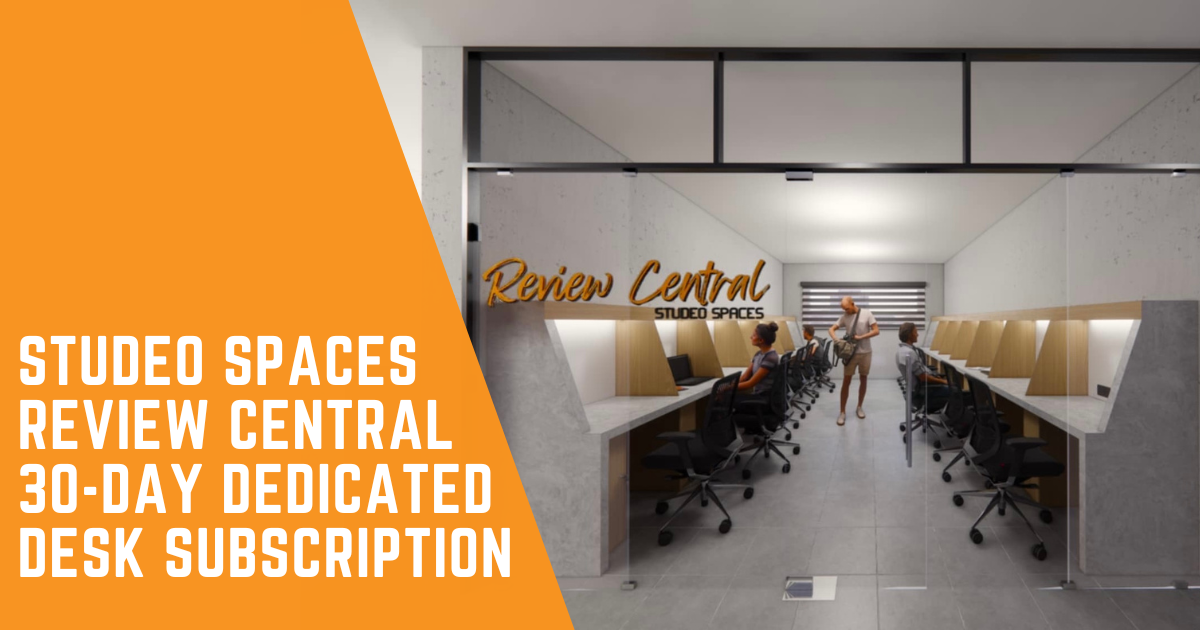
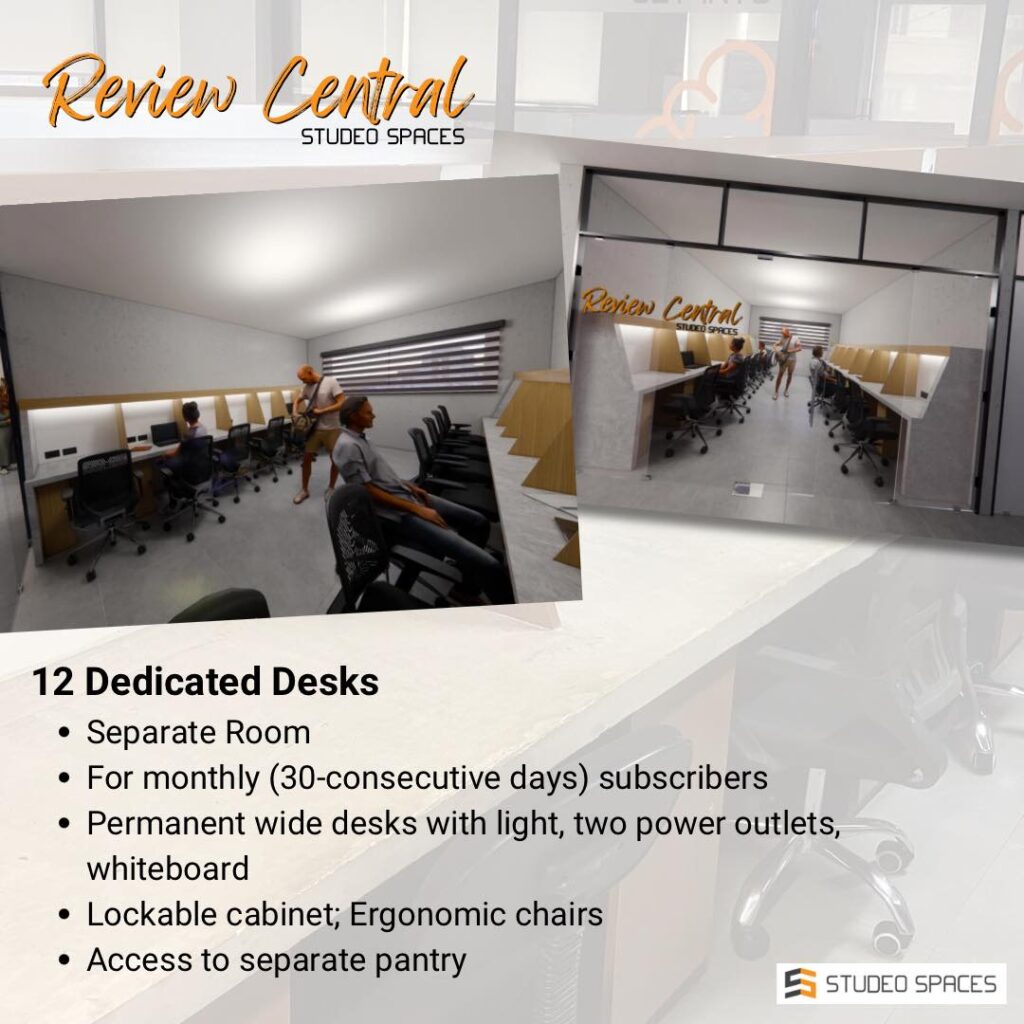
Opening this August 4, 2024: Studeo Spaces Review Central Dedicated Desks Monthly Subscription.
for only P5,000.00 for 30 consecutive days or just P166.67/ day. Less than the price of your regular Venti Coffee Latte!
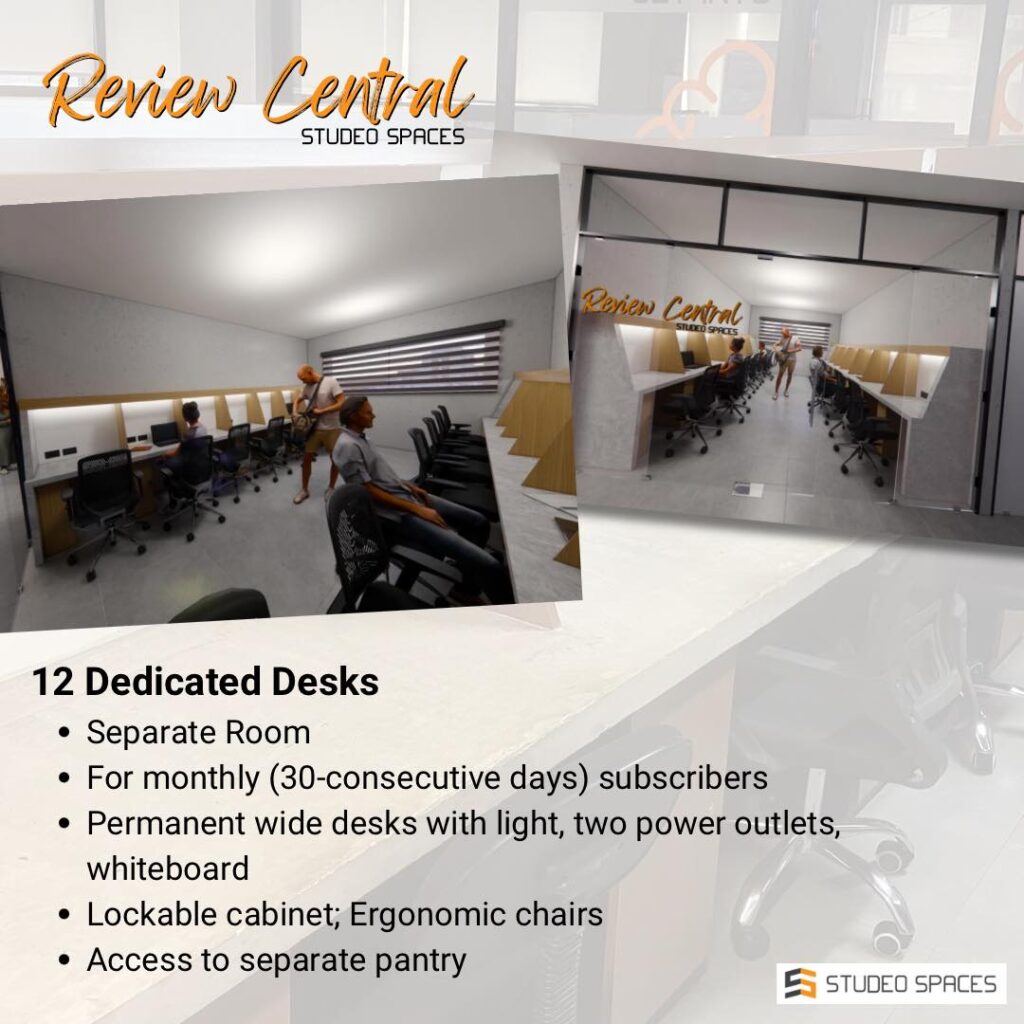
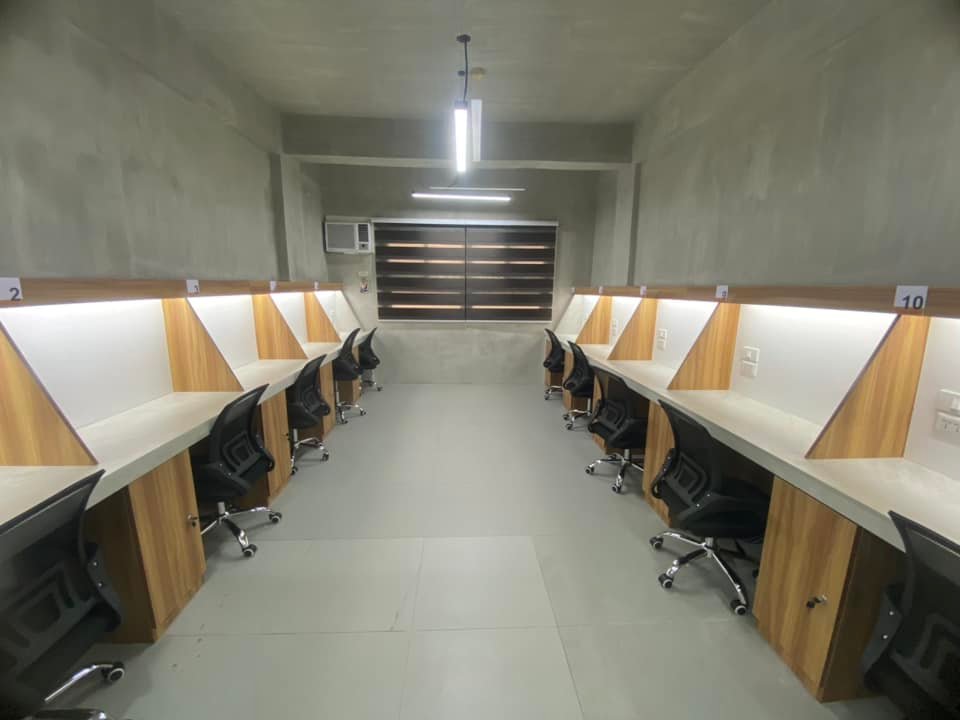
located in a separate room for more quiet, productive study or work
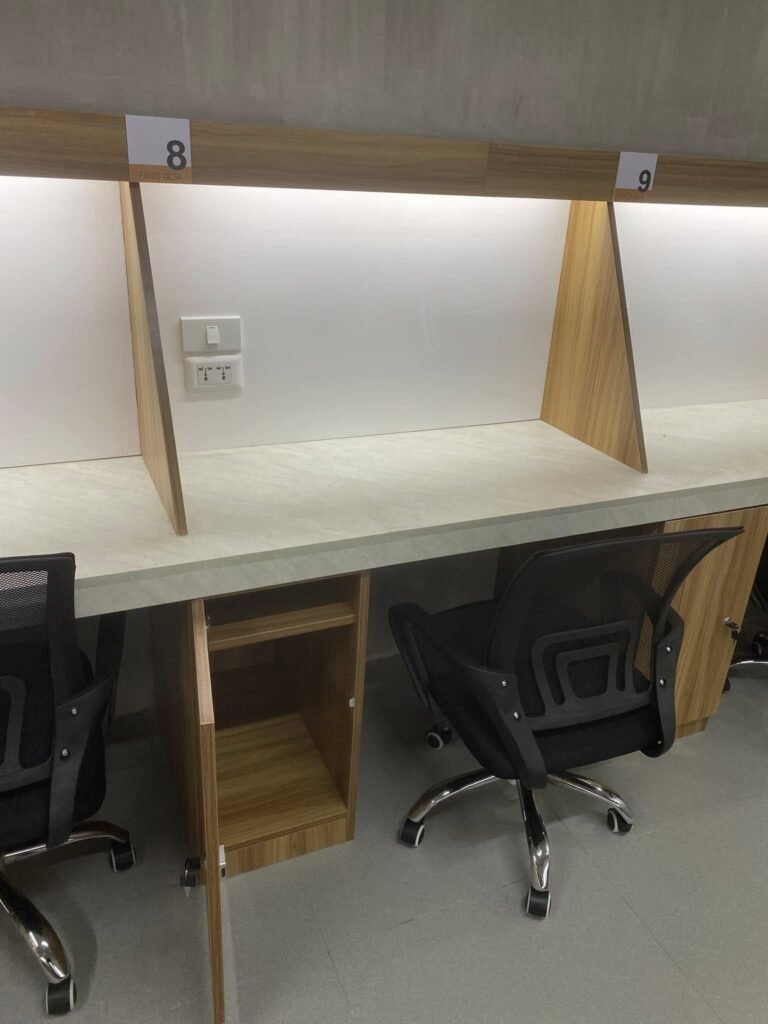
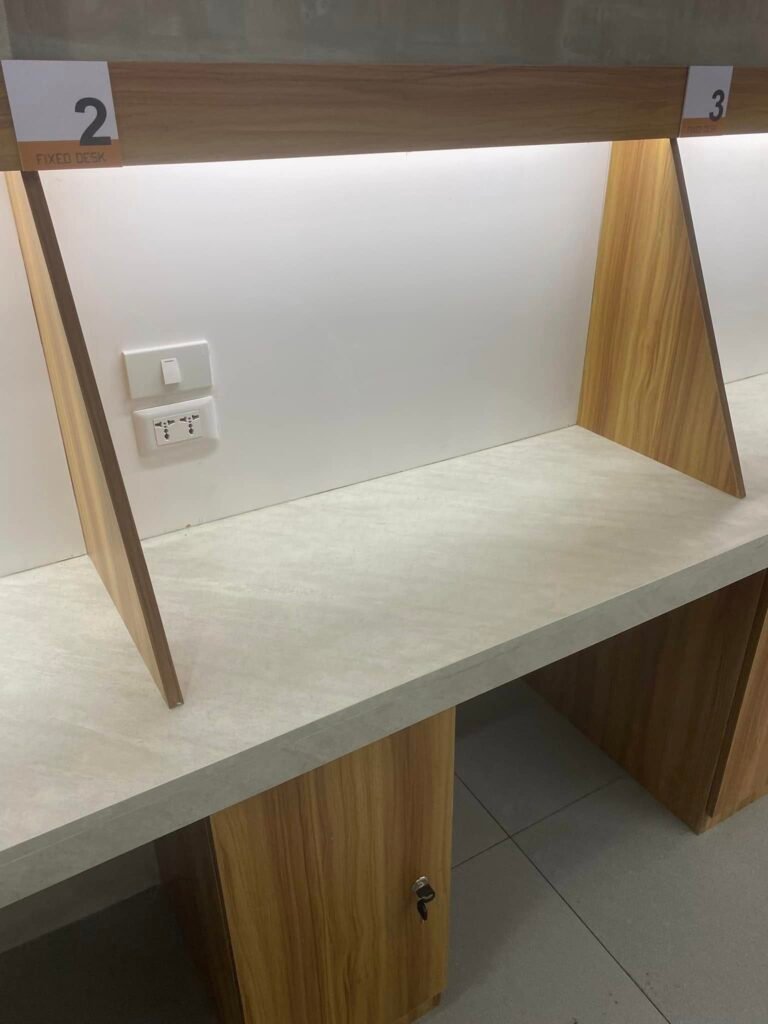
only 12 desks are available; the same desk is yours for the whole subscription duration. You may keep and leave your stuff under lock and key in the under-desk cabinet
accessible from 8:00 AM to 12:00 MN
wide desk (0.8 – 0.9 meter) with light, two power outlets, and a whiteboard
ergonomic chair
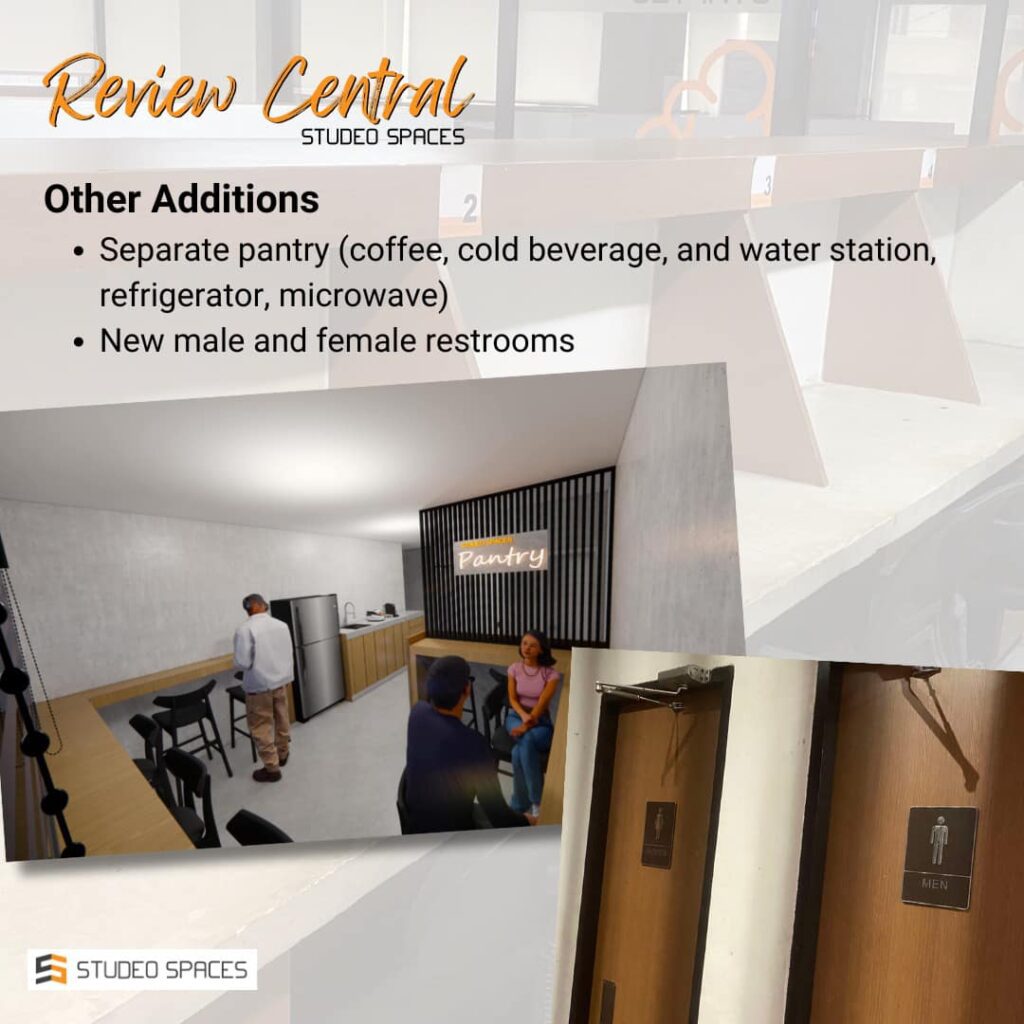
full access to the same-floor pantry with free-flowing coffee, iced beverages (juice, tea, or coffee), hot and cold purified water, and free use of refrigerator and microwave for food brought from outside. There are no corkage fees.
same-floor male and female restrooms
fast, stable, broadband internet (five ISPs for redundancy) with same room access point
Desks are now open for reservations. Send us a message to inquire and/or reserve.
Studeo Spaces Study Hub is located at Dapitan and Dela Fuente Streets, Sampaloc, Manila (7-11 on the ground floor). Google Maps/Waze/Grab Pins: Studeo Suites or Studeo Spaces
We are open from 8:00 AM to 12:00 MN, seven days a week, including holidays and inclement weather. For an additional P100.00, we can extend to 6:00 AM at the Glassbox NightShift.
Studeo Spaces Study Hub presents a compelling option for students and professionals in Manila who need a dedicated and productive study or work environment. Their 30-Day Dedicated Desk subscription offers a range of amenities and conveniences at a competitive price point, with a strong emphasis on providing a quiet, focused environment. The inclusion of multiple space options, blog content, and a commitment to reliable internet and extended hours further position them as a valuable resource for their target demographic. The recent updates showcase ongoing improvements and additions to their services, further highlighting the business’s investment in the business.
Frequently Asked Questions About Studeo Spaces 30-Day Dedicated Desks.
What is the Studeo Spaces Review Central 30-Day Dedicated Desk Subscription, and how much does it cost?
The Studeo Spaces Review Central 30-Day Dedicated Desk Subscription provides a personal workspace for 30 consecutive days. It costs P5,000.00 for the entire period or roughly P166.67 per day. This is advertised as less than the cost of a typical large coffee.
What amenities are included with the dedicated desk subscription?
The subscription includes a permanent desk (0.8 meters wide) with a light, two power outlets, and a whiteboard. It also provides an ergonomic chair, a lockable under-desk cabinet, access to a pantry with complimentary coffee, iced beverages, hot and cold water, and the use of a refrigerator and microwave. Access to restrooms is also included. Furthermore, the space offers fast and reliable broadband internet with redundant ISPs.
What are the operating hours for Studeo Spaces, and can I access it outside of regular hours?
Studeo Spaces is open seven days a week from 8:00 AM to 12:00 MN, including holidays and during inclement weather.
Where is Studeo Spaces located, and how can I find it?
Studeo Spaces Study Hub is located at the corner of Dapitan and Dela Fuente Streets, Sampaloc, Manila. It shares a building with a 7-11 on the ground floor. You can locate it using Google Maps, Waze, or Grab by searching for “Studeo Suites” or “Studeo Spaces.”
Besides the dedicated desk subscription, what other services or room options does Studeo Spaces offer?
Studeo Spaces offers various other options, including All-Day, All-Night Passes, 15-Day Prepaid Passes, and private rooms,s including Barkadaral Rooms, Solo Rooms, and the Glassbox Night Shift. They also feature high-top desks and other room types, which can be booked for varying periods.
What kind of content and resources does Studeo Spaces provide besides physical spaces?
Studeo Spaces provides various resources, including blog posts and articles covering topics such as study strategies and tips, exam preparation (including managing anxiety and improving exam-taking skills), maximizing productivity through the flow state, and a list of study hubs in Manila.
Does Studeo Spaces offer food and beverage options?
While there are no corkage fees, and patrons can bring their food, Studeo Spaces offers a free pantry with coffee, iced beverages (juice, tea, or coffee), and hot and cold purified water. Additionally, Rekap Barista Coffee is also available at the location.
How can I book a desk or room at Studeo Spaces, and what are some of the latest news?
You can book a desk or room by sending Studeo Spaces a direct message for inquiries and reservations. Recent news includes the availability of new high-top desks, Barkadaral Rooms for four-hour use, and the addition of Rekap Barista Coffee. You can find the latest news and booking information on the Studeo Spaces website.
SPECIAL ANNOUNCEMENT: Studeo Spaces Study Hub will temporarily close its doors from July 21, 2024 (Sunday) to August 11, 2024 (Sunday) as we prepare to present Studeo Spaces REVIEW CENTRAL!
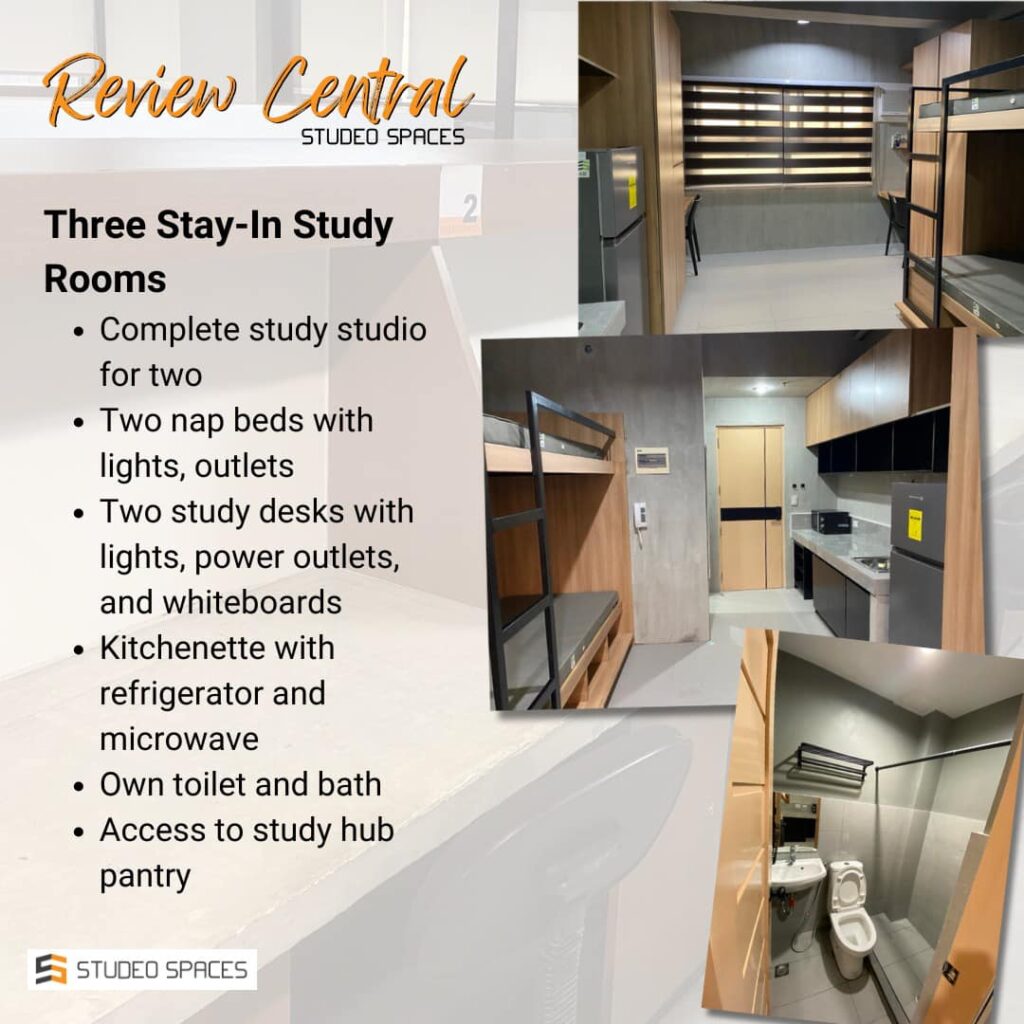
A whole floor or 165 square meters of new study spaces that will feature:
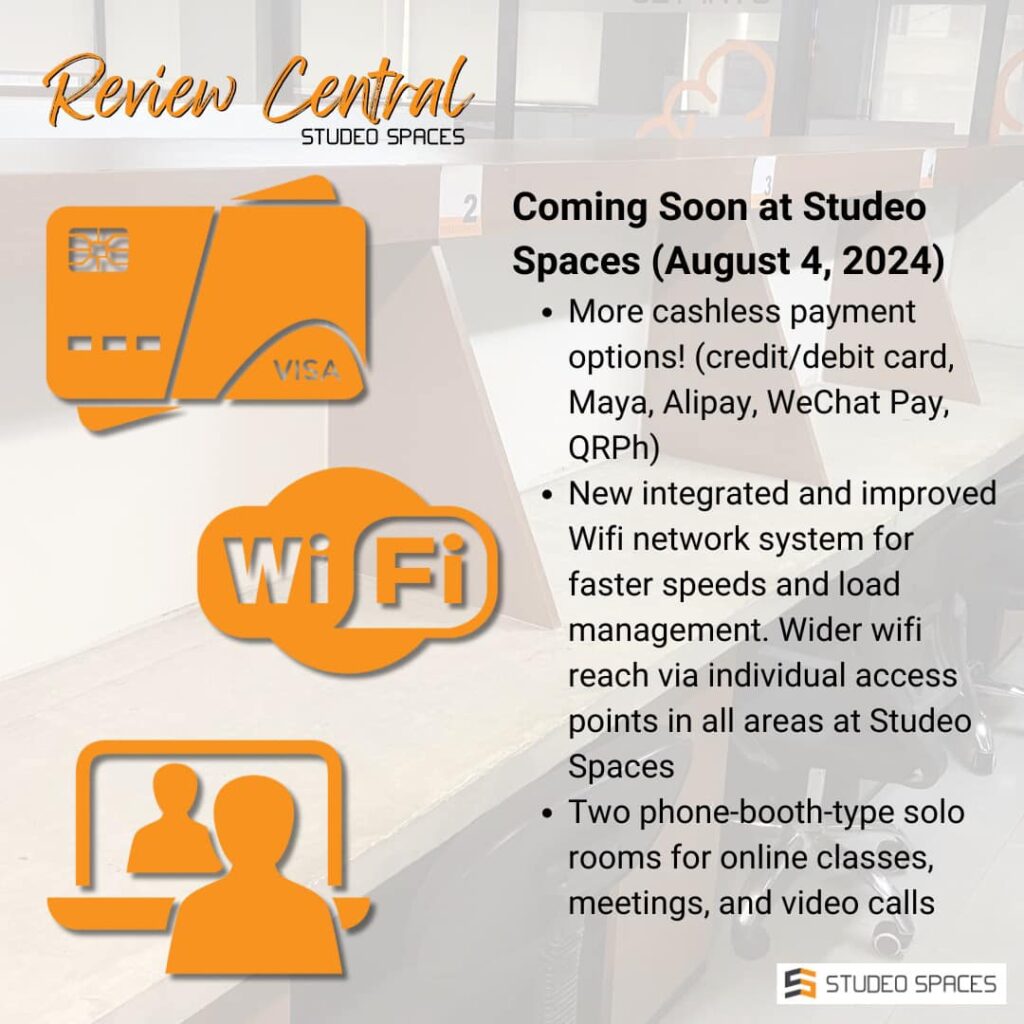
We will also use this downtime to install a new Wi-Fi network system to consolidate our five (5) internet service providers (ISPs) with load balancing for uninterrupted Wi-Fi access and wider reach. We will install individual access points in all areas of the facility.
As we open, we will add new cashless payment options like credit and debit card payments and more e-wallet payment options (AliPay, WeChat Pay, Maya, and QRPh).
We will also set up two Phone-Booth-Type Solo Rooms on the second floor for online classes, meetings, and video calls.
We apologize for this downtime as we further improve and expand our facilities and services.
Thank you for understanding. We look forward to seeing you all on Monday, August 5, 2024, when we reopen our doors to a newer, bigger, and better Studeo Spaces Study Hub!
Studeo Spaces Study Hub is located at Dapitan and Dela Fuente Streets, Sampaloc, Manila (7-11 on the ground floor). Google Maps/Waze/Grab Pins: Studeo Suites or Studeo Spaces
We are open from 8:00 AM to 12:00 MN (extendable to 6:00 AM at the Glassbox NightShift for just an additional P100.00), seven days a week, including holidays and inclement weather.
Have you ever found yourself staring at a pile of textbooks, feeling completely unmotivated to tackle the mountain of studying ahead? Preparing for board exams can be an overwhelming and daunting experience. However, staying motivated is key to successfully navigating this challenging period. This article explores strategies and tips for maintaining drive and enthusiasm while studying for these crucial exams.
Understanding the Importance of Motivation
Why Motivation Matters
Motivation is the driving force behind our actions. Maintaining high levels of motivation can significantly impact your performance when studying for board exams. It helps you stay focused, manage time efficiently, and retain more information. Essentially, motivation acts as the fuel that powers your journey towards academic success.
The Psychological Aspect of Motivation
Our brains are wired to seek rewards. Understanding this can help in devising methods to boost motivation. Setting achievable goals and rewarding yourself for meeting them can create a positive reinforcement loop that encourages continued effort.
Setting Clear Goals and Objectives
SMART Goals
One effective way to stay motivated is by setting SMART goals. These are:
Specific: Clearly define what you want to achieve.
Measurable: Ensure that your goals are quantifiable.
Achievable: Set realistic and attainable goals.
Relevant: Align goals with your overall objectives.
Time-bound: Establish a deadline to create a sense of urgency.
For example, instead of saying, “I need to study chemistry,” a SMART goal would be, “I will study two chapters of chemistry by 5 PM.“
Break Down Big Tasks
Large goals can be intimidating. Break them into smaller, manageable tasks. This approach makes the overall goal seem less daunting and provides a sense of accomplishment as you complete each smaller task.
Creating a Study Schedule
The Importance of a Study Schedule
Creating a structured study schedule can drastically improve your efficiency and motivation. It helps allocate specific time slots for each subject, ensuring a balanced approach to your preparation.
Time Management Techniques
Consider implementing time management techniques such as the Pomodoro Technique, which involves studying for 25 minutes and then taking a 5-minute break. This method can enhance focus and prevent burnout.
Techniques to Stay Engaged
Active Learning
Active learning involves engaging with the material in a way that makes it easier to understand and remember. Techniques include summarizing information in your own words, teaching the material to someone else, and creating mind maps or flashcards.
Group Study
Studying in groups can be highly motivating. It provides a platform to share knowledge, ask questions, and stay accountable. However, ensure that the group remains focused and does not become a distraction.
Stress Management
Importance of Stress Management
Studying for board exams is inherently stressful. Managing this stress is crucial for maintaining motivation and overall well-being.
Relaxation Techniques
Incorporating relaxation techniques such as deep breathing, meditation, and exercise can help manage stress. Taking regular breaks and ensuring you get enough sleep is also vital.
Staying Positive and Building Confidence
Positive Self-Talk
The way you talk to yourself can significantly impact your motivation levels. Practice positive self-talk by focusing on your strengths and achievements rather than dwelling on failures or setbacks.
Building Confidence
Confidence comes from preparation and practice. You’ll build the knowledge and skills to tackle your board exams confidently by consistently studying and revising. Additionally, practicing past exam papers can provide a clear idea of what to expect, boosting your confidence.
Leveraging Technology and Resources
Online Resources
In today’s digital age, a wealth of online resources is available to aid your study process. Websites, apps, and online courses can offer additional explanations, practice tests, and study guides.
Study Apps
Study apps like Quizlet, Anki, and Evernote can help organize your study material, create flashcards, and set reminders for study sessions, making your revision process more efficient and engaging.
Rewarding Yourself
Importance of Rewards
Setting up a reward system can keep you motivated throughout your study period. After completing a study session or achieving a specific goal, reward yourself with something you enjoy, such as a favorite snack, a movie, or a fun activity.
Types of Rewards
Short-Term Rewards
Long-Term Rewards
Small Treats
A favorite snack or drink
Short Breaks
Taking a walk or a quick nap
Entertainment
Watching an episode of a TV show
Leisure Activities
Planning a day out or a vacation
Staying Consistent
Importance of Consistency
Consistency is key when it comes to studying for board exams. Sticking to your study schedule and maintaining regular study habits will ensure steady progress and help avoid last-minute cramming.
Creating a Routine
Establish a daily routine that includes time for studying, breaks, meals, and relaxation. A well-balanced routine can help maintain motivation and prevent burnout.
Seeking Support
Family and Friends
Your family and friends can be a great source of support and motivation. Share your goals and progress with them, and do not hesitate to ask for their encouragement and help when needed.
Professional Guidance
If you struggle despite your best efforts, seeking professional guidance from a tutor or mentor can provide additional motivation and support.
Reflecting on Your Progress
Self-Assessment
Regularly assess your progress by taking practice tests and reviewing your performance. Identifying your strengths and areas for improvement can help you adjust your study plan accordingly and stay motivated.
Celebrating Achievements
Celebrate your achievements, no matter how small they may seem. Recognizing and appreciating your efforts can boost your motivation and keep you focused on your goals.
Finding Your Optimal Study Environment
Staying motivated while preparing for board exams can be a herculean task, but Studeo Spaces Study Hub offers the ideal solution for those determined to succeed. Nestled in the heart of Sampaloc, this unique study environment is dedicated to helping students and professionals achieve a state of “Flow”—a condition of hyper-focus and unmatched productivity.
At Studeo Spaces Study Hub, distractions vanish, and concentration soars, creating an atmosphere that elevates academic and professional performance. With extended daily hours and an unwavering commitment to being open every day, including holidays, this study sanctuary ensures you can access your optimal study environment whenever needed. By offering a meticulously designed space that prioritizes focus and encouragement, Studeo Spaces Study Hub makes it significantly easier to stay motivated and excel in your board exams.
The Ideal Study Space
Your study environment plays a crucial role in maintaining motivation. Aim for a quiet, well-lit space that is free from distractions.
Studeo Spaces Study Hub: A Perfect Study Environment
At Studeo Spaces Study Hub, they believe in creating a space that fosters a state of hyper-productivity and concentration known as the “flow state.” Located in Sampaloc, their premier destination is designed to help individuals unleash their focus and unlock their full potential.
They aim to provide a supportive environment where students and professionals can escape distractions and elevate their studies or work. Studeo Spaces Study Hub is meticulously designed to cater to those seeking an optimal atmosphere for studying or working, helping individuals achieve their goals and reach a state of flow where they can immerse themselves fully in their tasks.
Their tagline, “Get Into the Flow,” encapsulates their commitment to helping individuals achieve a state of hyper-focus and productivity. Whether preparing for exams or looking to enhance your professional performance, Studeo Spaces Study Hub provides the perfect environment for you to thrive. Open seven days a week, including weekends, holidays, and even during inclement weather, you can access their facilities from 8:00 AM to 12:00 MN (extendable to 6:00 AM at the Glassbox NightShift for just an additional P100.00).
Benefits of Studying at Studeo Spaces Study Hub
Benefits
Description
Hyper-Productivity
The design and ambiance foster a state of hyper-focus and concentration.
Escape Distractions
A distraction-free environment ideal for studying and working.
Flexibility
Access the hub as frequently as needed, between 8:00 AM to 12:00 MN (extendable to 6:00 AM at the Glassbox NightShift for just an additional P100.00).
Accessibility
Centrally located at the corner of Dapitan and Dela Fuente Streets, Sampaloc, Manila.
Extended Hours
Open every day, ensuring you have ample time and opportunity to study.
Conclusion
Staying motivated while studying for board exams can be challenging, but it is achievable with the right strategies and mindset. Setting clear goals, creating a structured study schedule, finding an ideal study environment like Studeo Spaces Study Hub, and leveraging various motivational techniques can significantly impact your preparation process. Remember to manage stress, stay positive, and seek support when needed. By staying consistent and celebrating your progress, you can maintain the drive and enthusiasm required to succeed in your board exams.
Studeo Spaces Study Hub awaits you to help you “Get Into the Flow” and reach your full potential. Embrace the journey, stay motivated, and give your best effort—success is within your grasp!
List of Study Hubs in Manila: A Handy Guide offers an overview of the different study hubs in Manila, guiding students and professionals to ideal spots for enhanced productivity. This handy guide explores various locations, helping readers find the perfect study space to suit their needs.
Have you ever found yourself searching for the perfect study spot in Manila, only to realize the options are overwhelming? With numerous study hubs around the city, finding a suitable place for uninterrupted work or study can be challenging. In this List of Study Hubs in Manila guide, we’ll list most of the best study hubs in Manila, offering you a hassle-free way to find the ideal environment for productivity.
Understanding the Importance of a Study-friendly Environment
A conducive study environment enhances focus, concentration, and overall productivity. The right study hub can significantly impact a student’s or professional’s ability to absorb information, understand complex concepts, and perform well in exams. Therefore, choosing the right location is not just a matter of convenience but also a strategic decision for achieving academic and professional success.
Factors to Consider When Choosing a Study Hub
Before diving into specific study hub locations in Manila, it’s essential to understand the factors that can make or break a study environment. Here are some key considerations:
Accessibility and Location
The study hub should be easily accessible whether you commute by public transportation, drive, or bike. Proximity to your home or school can save commuting time and reduce stress, allowing you to focus better on your studies.
Ambiance and Comfort
The atmosphere of a study hub plays a significant role in productivity. Look for hubs that offer comfortable seating, adequate lighting, and a quiet environment conducive to concentration.
Amenities and Facilities
The availability of essential amenities, such as high-speed internet and power outlets, can greatly enhance your study experience. Additional facilities, such as food and beverage options, can also be a plus.
Cost and Membership Options
Consider your budget and whether the study hub offers flexible pricing plans, day passes, or membership options that fit your needs.
Security and Safety
The study hub should be in a safe location and offer security measures, such as surveillance cameras and secure entry points, to ensure your well-being and the safety of your belongings.
List of Study Hubs in Manila
Manila hosts various study hubs, each with unique features and amenities. Below is a list of some of the city’s most popular and highly recommended hubs.
Just-In-Time Study Hub and Coworking Space Mendiola Square, 2138 C.M. Recto Ave, Quiapo, Manila, 1001 Metro Manila https://www.facebook.com/jit.studyhub +63926 2675904
WhiteBoard Student Lounge and Co-Working Space 1221 Gen V Concepcion St., Barangay 470, Zone 46, Sampaloc, Manila, 1008 Metro Manila https://www.facebook.com/WhiteboardDapitan +639083531590
Among the featured destinations, Studeo Spaces Study Hub stands out for its commitment to creating an environment conducive to achieving the Flow State—hyper-productivity and concentration. Located in Sampaloc, Manila, Studeo Spaces provides a distraction-free zone accessible seven days a week, offering optimal conditions for students to immerse themselves fully in their studies and excel in their academic or professional endeavors. With its strategic location and meticulously designed space, Studeo Spaces Study Hub empowers individuals to elevate their focus and performance, embodying its tagline, “Get Into the Flow.”
Studeo Spaces Study Hub
Studeo Spaces Study Hub fosters a state of hyper-productivity and concentration, known as the “Flow State.” Located in Sampaloc, this premier destination caters to individuals seeking an optimal atmosphere for studying or working. They aim to provide a supportive environment where students and professionals can escape distractions and elevate their performance.
Location: Corner of Dapitan and Dela Fuente Streets, Sampaloc, Manila (7-11 on the ground floor) Operating Hours: Open every day from 8:00 AM to 12:00 MN (extendable to 6:00 AM at the Glassbox NightShift for just an additional P100.00). Highlights:
Flow State Environment: Designed to promote peak performance and productivity.
Accessibility: Located in a central area with easy access via public transportation.
Facilities: High-speed internet, comfortable seating, adequate lighting, and security measures.
Before heading to a study hub, define what you want to accomplish. Break your tasks into manageable chunks and set specific, achievable goals for each study session.
Use Productivity Tools
Use tools like timers, to-do lists, and productivity apps to stay organized and on track. Techniques like the Pomodoro Technique, which involves working in short, focused intervals, can be particularly effective.
Minimize Distractions
Choose a study spot within the hub that minimizes potential distractions. Turn off notifications on your devices, and consider using noise-canceling headphones if necessary.
Stay Hydrated and Take Breaks
Keep a water bottle handy and take regular breaks to avoid burnout. Short breaks help maintain focus and prevent fatigue.
Maintain a Positive Study Routine
Consistency is key. Establish a study routine that works best for you and stick to it. Regular habits can create a sense of discipline and rhythm in your study sessions.
Conclusion
Finding the perfect study hub in Manila can significantly enhance your ability to concentrate and perform well. Manila has many options to suit your needs, whether you prefer a quiet, isolated environment or a more dynamic and collaborative space.
Studeo Spaces Study Hub stands out, particularly for its commitment to helping students and professionals get into the Flow State for maximum productivity. Located at the corner of Dapitan and Dela Fuente Streets in Sampaloc, Manila, this exceptional study hub is open daily from 8:00 AM to 12:00 MN (extendable to 6:00 AM at the Glassbox NightShift for just an additional P100.00), providing a reliable and conducive environment for your study or work needs. Choosing the right study hub and implementing effective productivity strategies can easily unlock your full potential and achieve your academic and professional goals.
Explore these study hubs, find the one that best fits your needs, and enhance your productivity today!
Studeo Suites Properties, Inc., owner and operator of Studeo Spaces Study Hub, is officially registered with the Bureau of Internal Revenue (BIR). You can verify our digital registration badge anytime by scanning the QR code above or visiting BIR Online Services.

 Studeo Spaces Study Hub is located at the corner of Dapitan and Dela Fuente Streets, Sampaloc, Manila (7-11 on the ground floor). Google Maps/Waze/Grab Pins: Studeo Suites or Studeo Spaces
 We are open from 8:00 AM to 12 MN, seven days a week, including holidays and inclement weather. We do not close due to private events since we don’t host them.